A flexible, permanent solution to water leaks caused by hairline cracks, cold joints and micro-pores. With Dryvatec acrylate gel — an expert team with 15+ years of experience in Istanbul and Izmir.
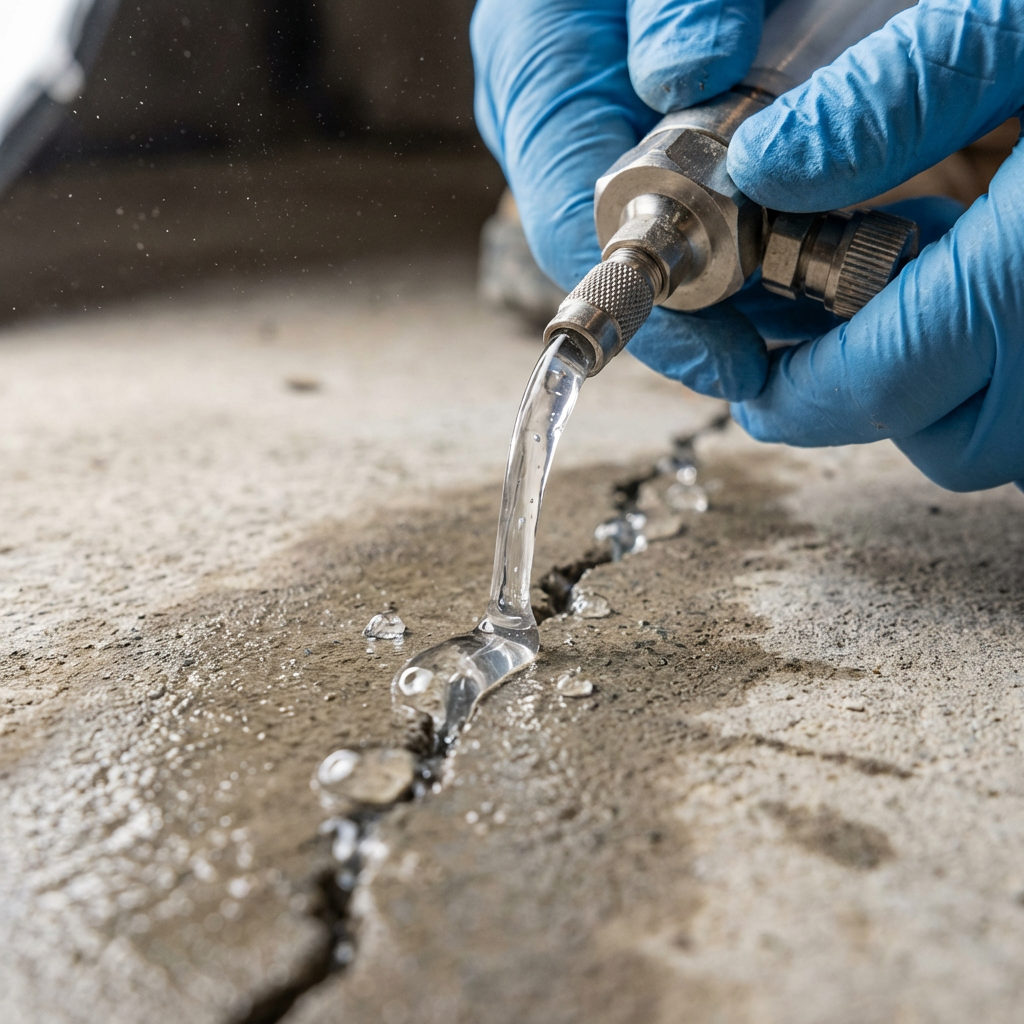
Acrylate gel injection is a precision waterproofing method in which a water-based, low-viscosity resin is injected under pressure into hairline cracks, cold joints and concrete pores. Injected through installed packers, Dryvatec acrylate gel turns into a flexible gel on contact with water, stopping the leak and accommodating structural movement. It is safe to use even in potable water tanks and sensitive structures. The application is completed in 1-2 days and carries a 5-year written warranty.
Acrylate gel injection waterproofing is an advanced injection technique used to stop water leaks originating from hairline cracks, cold joints, micro-pores and honeycombed areas in reinforced concrete structures. The low-viscosity acrylate resin is injected into the crack with a pressure pump; on contact with water it expands in a controlled way, fills the crack completely and forms an elastic water barrier. The same gel family is also used for curtain (grout) injection, where the gel is injected through the structure into the surrounding ground to form an external waterproof screen.
Unlike polyurethane injection, acrylate gel retains its flexibility after curing. It therefore accommodates thermal expansion, vibration and micro-movement within the concrete, delivering long-term waterproofing. Its ability to penetrate hairline cracks as fine as 0.1 mm is the key property that sets it apart from other injection materials.
With more than 15 years of site experience and its own Dryvatec acrylate gel injection materials, İMG Yapı Yalıtım Mühendislik A.Ş. is one of Türkiye's leading applicators in this field.
As concrete sets and cures, it inevitably shrinks. During this shrinkage, hairline cracks form on the surface and within the body of the concrete. In addition, the cold joints that form between successive pours create natural pathways for water to penetrate the concrete. When these cracks and joints are not adequately waterproofed during the original construction, water leaks begin over time.
Hairline cracks are hard to spot with the naked eye; they are generally between 0.1 mm and 0.3 mm wide. Yet even cracks this fine draw water in strongly through capillary action. When the groundwater level rises, or under rainwater loading or hydrostatic pressure, these hairline cracks turn into active leak points. At first they show only as slight dampness; over time they lead to active water ingress, mould growth and reinforcement corrosion.
Cold joints form when one layer of a concrete pour has begun to set before the next layer is placed on top, preventing a full bond. These junctions are the structurally weakest zones and the points where water ingress is seen most often. Pipe penetrations, formwork tie holes and honeycombed areas create water entry points in the same way.
The critical fact: research shows that when the steel reinforcement inside concrete stays in continuous contact with water for 10 years, the bar diameter is reduced by 34% and the load-bearing capacity by 67%. Water seeping continuously through hairline cracks corrodes the reinforcement, weakening the building's structural system and threatening its earthquake safety. That is why hairline crack repair and waterproofing are urgent.
Water seeping to the surface through cracks barely visible to the eye, creating damp patches and active drip points
Continuous water passage through the weak junctions between concrete pour layers, with wetting along the joint line
Mould growth fed by the chronic leak, respiratory complaints and a decline in quality of life
Water seeping through hairline cracks rusting the steel reinforcement, weakening the structural system and causing structural damage
If you have noticed one or more of the signs below, your building has a waterproofing problem that calls for injection. Early intervention minimises structural damage and cost.
Water traces and wetness forming along a fine crack line on a wall or ceiling surface. Seen most clearly at cold joints and concrete junctions.
White, powder-like salt crystals forming along the crack line or on the concrete surface. A clear indicator that water passing through the concrete is carrying dissolved minerals to the surface.
Black, green or grey mould staining around hairline cracks and cold joints. A clear indicator of a chronic damp leak, and a health risk.
Active water dripping from a crack or joint. An active leak that becomes more pronounced in rainy periods or when the groundwater level rises.
The smell of mould and damp noticed on entering the room heralds a high relative humidity and a chronic leak. Ventilation will not shift it; the source has to be eliminated.
Plaster or paint bubbling and separating from the wall as the moisture in the concrete pushes outwards. A sign of water pressure behind the crack.
The working principle of acrylate gel injection and how it differs from other injection materials.
Acrylate gel has a water-like, low-viscosity flow. It therefore penetrates even 0.1 mm hairline cracks that polyurethane injection cannot reach. The material travels along the crack, reaching the finest pores and achieving complete filling.
On contact with the water inside the crack, the injected acrylate gel expands (swells) in a controlled way. This expansion fills the crack under pressure and seals it. The swelling rate is governed by the formulation of the material and does no harm to the concrete.
While polyurethane injection cures to a hard, rigid structure, acrylate gel stays flexible even after curing. This flexibility accommodates thermal expansion, vibration, settlement movement and seismic activity in the concrete. Even if the crack moves again, the acrylate gel barrier keeps its integrity.
Cured acrylate gel is resistant to the alkaline concrete environment, the minerals in groundwater and low-concentration acids. It does not degrade, dissolve or lose its effect over time. It can be used safely in potable water tanks and food facilities.
Acrylate gel retains its performance between -20°C and +80°C. It withstands freeze-thaw cycles. It can therefore be applied safely in every climate region of Türkiye and in every season.
Even if the acrylate gel shrinks as it dries out, it swells again on renewed contact with water and restores the seal. This re-swelling property provides continuous protection even through seasonal changes in the groundwater level.
The two injection methods have distinct advantages for different crack types. The right method is determined by an on-site survey.
At İMG Yapı Yalıtım Mühendislik A.Ş. we can apply acrylate gel and polyurethane injection together or separately. During the on-site survey the crack type, its width and the water pressure are assessed to determine the most suitable material and method.
The systematic, controlled application process we have developed over more than 15 years of site experience.
Our expert team inspects the areas with water ingress thoroughly. Hairline cracks, cold joints, honeycombed areas, pipe penetrations and active leak points are identified with professional moisture measurement instruments. Crack widths are measured, the water pressure is assessed and the injection points are marked on a plan. Accurate detection is the foundation of a successful injection application; an incomplete survey means an incomplete cure.
Injection holes are drilled along the crack line at a 30-45 degree angle and at 15-25 cm intervals. The hole diameter is between 10 and 14 mm, and the depth is adjusted to the nature of the crack and the thickness of the concrete. It is critical that the holes are drilled so as to intersect the crack line; otherwise the injection material cannot reach the crack. Loose particles on the surface are cleaned off and the hole mouths are prepared.
Special injection packers (nipples) are inserted into the drilled holes and tightened firmly with a screwdriver or spanner. The packers are the critical connection elements that prevent the material escaping back and the pressure being lost during pressurised injection. The packer type and size are selected to match the hole diameter. The spacing between packers is optimised for the crack width and the injection pressure.
Dryvatec acrylate gel injection material is injected into the crack in a controlled manner through the packers with a pressurised injection pump. The injection proceeds in sequence, starting from the lowest packer and working upwards. On contact with water the material swells in a controlled way, fills the hairline crack completely and forms a flexible water barrier. The injection pressure is set according to the crack width and depth; it is monitored carefully, as excessive pressure could damage the concrete.
Once the injection is complete, every leak point is checked one by one. Whether the material has filled the crack completely, whether the leak has stopped and any spread into adjacent areas are assessed. Additional injection is carried out at points where it is deemed necessary. A watertightness test verifies the success of the application. The packers are removed, the hole mouths are filled with structural mortar and the surface is cleaned.
After quality control is complete, the space is handed back and a written warranty certificate is issued. Under the warranty, any recurrence of a water leak caused by the application is remedied at no charge. Photographs of the application area are archived, and the injection points and the quantity of material used are put on record. Should any issue be reported during the warranty period, our team attends the site as soon as possible.
Acrylate gel injection can be applied in every kind of reinforced concrete structure with hairline cracks and cold joints.
For water leaks from hairline cracks and cold joints in below-ground retaining walls, acrylate gel injection is the primary solution — including curtain injection into the ground behind the wall. Applied together with a crystalline coating, full impermeability is achieved.
Widely applied in lift pits at wall-slab junctions, cold joints and hairline cracks. Its flexible structure withstands lift vibration.
Used safely for hairline crack repair in potable and utility water tanks. Once cured it is inert and harmless to drinking water. Compliant with TSE EN standards.
Acrylate gel injection stops water loss through pool shell cracks and junctions. Its flexible structure accommodates the temperature changes of the pool water.
In cracks and joints in metro tunnels, motorway underpasses and infrastructure works, acrylate gel injection provides a flexible solution that withstands traffic vibration.
In cracks in factory floors, cold stores and industrial structures, acrylate gel injection is an ideal solution thanks to its chemical resistance and wide temperature range.
For an acrylate gel injection application to be successful and long-lasting, the following technical requirements must be met in full.
In our acrylate gel injection work we use the acrylate gel injection, polyurethane injection and crystalline waterproofing materials of our own brand, Dryvatec. Because we manufacture the material ourselves, quality control is in our hands from start to finish. We serve with a direct manufacturer's assurance, with no intermediary margin.
Many waterproofing companies on the market buy in materials from various brands; we use Dryvatec products manufactured to our own formulation. This lets us fully control the material quality, batch consistency and the success of the application. Dryvatec injection materials are manufactured in accordance with TSE EN standards.
Watch real site footage and application details on our YouTube channel.
In injection work, the wrong material choice, a faulty pressure setting or an incomplete survey can make the problem worse instead of curing it. Choosing the right company is critical.
We hand over a written warranty certificate on all our acrylate gel injection work. Under the warranty, every issue is resolved at no charge. Our application archives are kept on record.
We manufacture the acrylate gel and polyurethane injection materials we use under our own Dryvatec brand. No intermediary margin — quality control is entirely in our hands. A direct manufacturer's assurance.
We detect cracks with professional moisture measurement instruments and thermal imaging. By finding even hairline cracks invisible to the eye, we eliminate the risk of an incomplete application.
We have carried out injection work in every kind of reinforced concrete structure since 2009. Thousands of successful projects in basements, lift pits, water tanks, pools and industrial facilities.
Rapid response to every district from our Maltepe (Istanbul) and Konak (Izmir) offices. Local teams and material depots in two major cities.
We use professional injection pumps, pressure-controlled systems and quality packers. The quality of the equipment directly affects the success of the application.
From our two offices we provide acrylate gel injection waterproofing services to every district of Istanbul and Izmir.
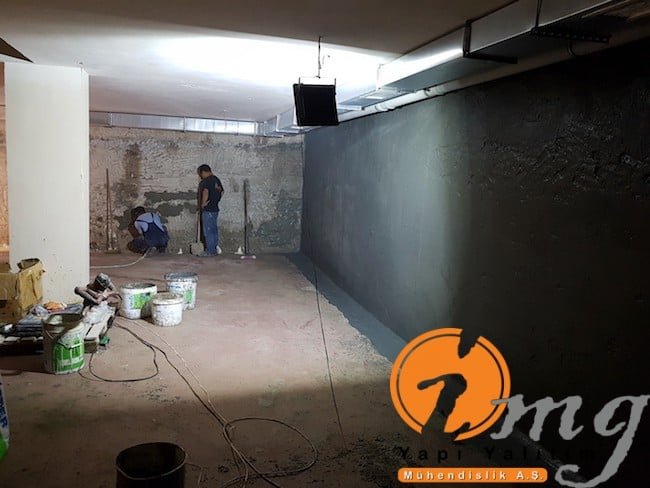
From our Maltepe office we provide acrylate gel injection waterproofing services to every district of Istanbul. On-site surveys and applications on both the European and the Asian side.
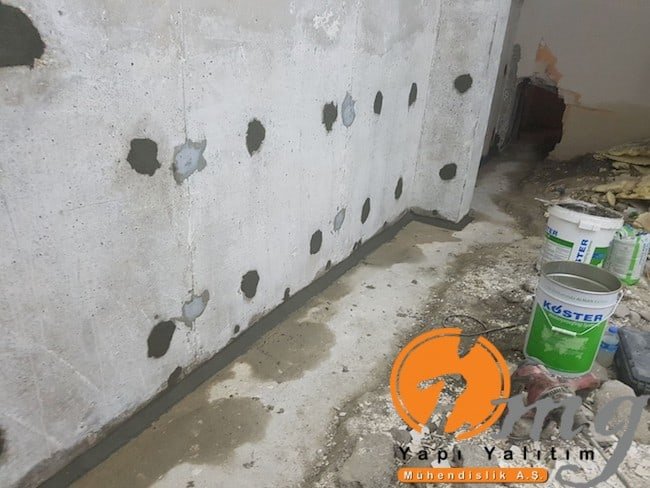
From our Konak office we provide acrylate gel injection waterproofing services to every district of Izmir. A wide service network across the Aegean Region.
We have compiled the questions our customers ask most, together with our technical answers.
Stop active water leaks in cracks and joints within minutes using acrylate gel and polyurethane injection.
DetailsA permanent solution to basement water ingress with no-dig negative-side crystalline tanking and acrylate gel injection.
DetailsHairline crack repair and watertightness applications in potable and utility water tanks.
DetailsFor the hairline crack and water leak problem in your building, fill in the survey request form or give us a call. Our technical team will get back to you as soon as possible for an on-site assessment and survey.