We trace mould and fungus back to its real cause, identify the moisture source and deliver a permanent solution with waterproofing works and an anti-fungal coating. Specialist team with 15+ years of experience in Istanbul and Izmir.
Anti-mould waterproofing systems are multi-layer applications that eliminate damp — the real cause of mould and fungus — at its root. The moisture source (a leak, condensation or rising damp) is identified first; once the existing mould has been removed, a damp-proof barrier is installed on the wall surface and an anti-fungal coating is applied. Unlike superficial repainting, the problem is resolved at the source rather than on the surface, so the result is permanent. A standard application is completed in 2-3 days.
An anti-mould waterproofing system is an integrated engineering solution that identifies and eliminates damp — the true cause of mould and fungus growth in buildings — at its source, and then protects the surface with anti-fungal coatings. Instead of merely cleaning the mould off the surface, it goes to the root of the problem and delivers a lasting result.
With more than 15 years of site experience and its own Dryvatec-branded materials, İMG Yapı Yalıtım Mühendislik A.Ş. is one of Türkiye's leading application specialists for permanent mould and fungus remediation. We manage the entire process in-house — from moisture source diagnosis through to the anti-fungal coating.
Mould and fungus are microscopic organisms that multiply rapidly in damp environments. The underlying cause of mould growth in buildings is uncontrolled moisture accumulation within the building fabric combined with inadequate ventilation. Different moisture sources — water leaks, condensation, capillary rising damp and surface sweating — create ideal conditions for mould colonies to form on wall, ceiling and floor surfaces. Mould spores are present everywhere in nature; but in damp, warm and poorly ventilated enclosed spaces they become active and multiply quickly.
Any environment where relative humidity exceeds 60%, the temperature stays between 15-30°C and organic surfaces (paint, gypsum plaster, timber, paper) are present carries a mould risk. Bathrooms, kitchens, basements, lofts and north-facing external walls are the most common mould zones. In winter especially, the growing difference between indoor and outdoor temperatures causes condensation on window reveals and external walls; these condensation points are ideal breeding grounds for mould colonies.
Many people regard mould as a purely cosmetic problem and try to deal with it through superficial cleaning or a fresh coat of paint. In reality, mould is a warning sign of structural damage and serious health risks. Building materials that remain permanently damp begin to deteriorate; gypsum decays, timber loses its structural properties, and paint and plaster blister and fall away. More importantly, airborne mould spores severely degrade indoor air quality and cause respiratory illness. Painting over mould is like giving a feverish patient nothing but paracetamol — it masks the symptom without treating the disease.
According to World Health Organization (WHO) data, people living in damp, mouldy buildings face a 30-50% higher risk of respiratory complaints. In damp environments, the risk of children developing asthma can rise by up to 40%. These statistics make it abundantly clear how serious a mould problem is and how urgently it requires intervention.
Moisture from roof, façade or plumbing leaks leads to mould colonies on walls and ceilings
On surfaces with a large indoor-outdoor temperature difference, water vapour condenses and creates an ideal damp environment for mould
Ground moisture rising by capillary action at ground-floor level causes mould and efflorescence at the base of walls
Mould spores cause respiratory illness, allergic reactions, headaches and chronic fatigue
If you have noticed one or more of the signs below, your living space has a mould problem. Early intervention protects both your health and your building.
Visible black, green, grey or white mould patches on walls, ceilings and corner junctions. They concentrate particularly in bathrooms, kitchens and around window reveals. Even a small patch can be the sign of an extensive mould colony.
A sharp, sour or earthy odour noticeable on entering the room. It comes from microbial volatile organic compounds (MVOCs) released during mould metabolism and indicates deteriorating indoor air quality.
Yellowish-brown moisture marks, wet patches and a tacky feel on the surface. Even before mould becomes visible, these stains are the forewarning of imminent mould growth.
Swelling, blistering or flaking of the paint film caused by moisture. Plaster softening and detaching from the wall due to damp. These signs show the moisture has been present for a long time.
Coughing, sneezing, nasal congestion, watery eyes and shortness of breath that worsen while at home. If these symptoms ease when you go outside, they point to mould exposure.
Water droplets constantly condensing on glazing and window frames. This condensation, worse in winter, paves the way for mould around the window and gradually rots the frame.
The biggest mistake made with mould is cleaning the surface while ignoring the moisture source underneath. Compare the permanent solution with the temporary fix.
At İMG Yapı Yalıtım Mühendislik A.Ş. we apply permanent — not temporary — solutions to mould problems. We identify the moisture source, carry out the waterproofing works and provide protection backed by a 5-year warranty with an anti-fungal coating. Rather than simply painting the surface, we eliminate the root of the problem.
Mould is not just a cosmetic issue. Airborne mould spores pose serious health risks. The World Health Organization (WHO) classifies living in mouldy environments as a health hazard.
Asthma, bronchitis, allergic rhinitis and upper respiratory tract infections. The incidence of these conditions is 30-50% higher among people living in damp environments. Chronic coughing and shortness of breath are the most common complaints. Existing asthma sufferers experience a marked increase in attack frequency when exposed to mould.
The risk of children who grow up in mouldy environments developing asthma can rise by up to 40%. Because children's respiratory systems are still developing, they are far more sensitive to mould spores. Mould exposure that begins at an early age lays the groundwork for chronic respiratory problems.
Prolonged exposure to mycotoxin-producing mould species (especially black mould — Stachybotrys) can lead to neurological symptoms such as chronic headaches, poor concentration, memory impairment and persistent fatigue.
Mould spores can trigger allergic reactions such as skin rashes, itching, eye redness, burning and watering. In people prone to allergies these reactions can be more severe and may become chronic.
Warning: In spaces with a mould problem, children, the elderly, pregnant women and people with weakened immune systems face a serious health risk. If you spot any sign of mould, seek professional help without delay.
Delivering a permanent cure for mould starts with correctly diagnosing the moisture source. Different moisture sources call for different waterproofing strategies.
A systematic application process focused on the moisture source, refined through more than 15 years of site experience.
Our specialist team inspects the space thoroughly, identifying the areas of concentrated mould growth, the moisture sources and the state of air circulation. Deep moisture readings are taken in walls, floors and ceilings using professional moisture meters and an infrared thermal imaging camera. We establish whether the moisture originates from a leak, condensation, rising damp or a hidden plumbing fault. This step underpins the entire application — without an accurate diagnosis, a permanent cure is impossible.
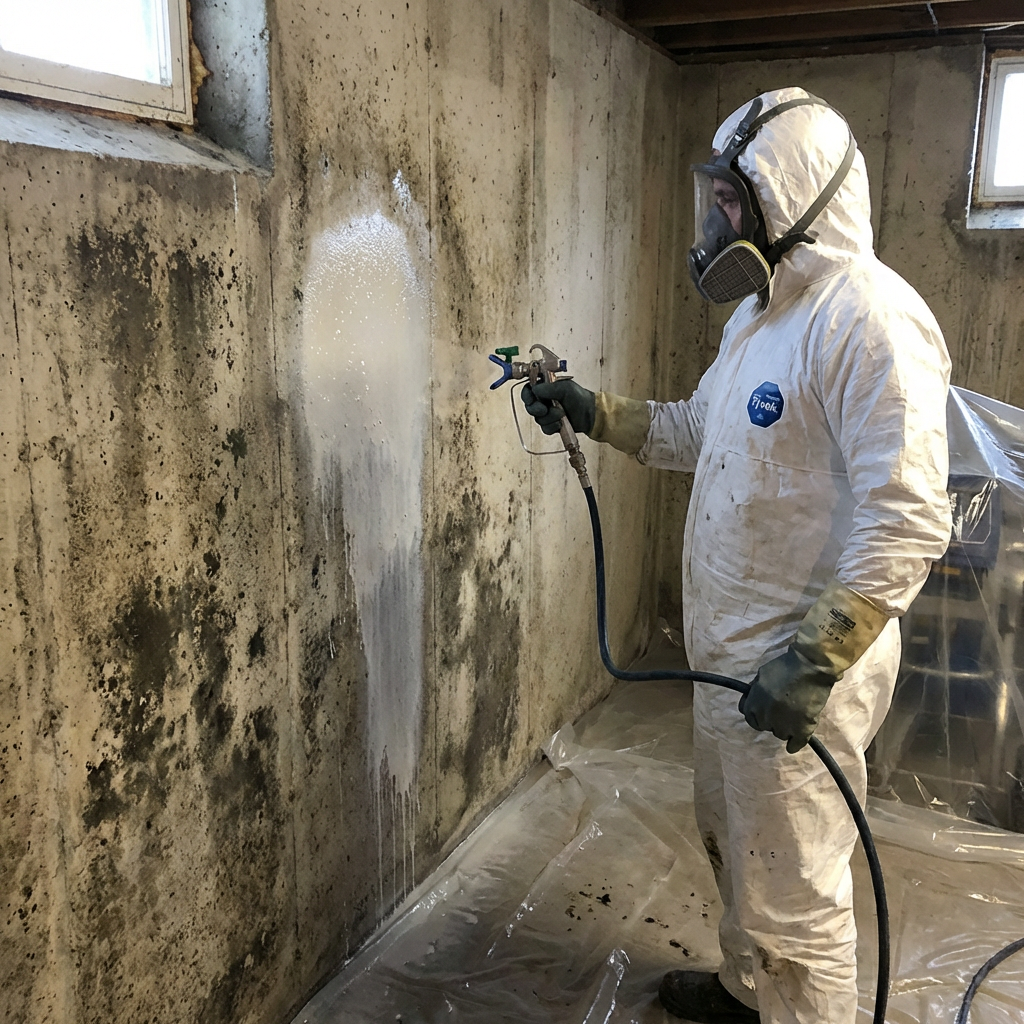
Existing mould and fungus colonies are completely removed from the surface with professional anti-fungal cleaners. A controlled removal procedure prevents spores from becoming airborne, and where necessary the area is isolated. In porous materials (plasterboard, timber) the deep-seated mould root structure is removed mechanically. Severely damaged materials are stripped out entirely. The aim at this stage is to eliminate not just the visible mould, but its root structure as well.
Plaster, paint, gypsum and loose layers damaged by moisture are removed. The surface is mechanically cleaned to expose a sound substrate for the damp-proof barrier and anti-fungal coating. Correct surface preparation is critical for the adhesion of the subsequent layers and the success of the application. Damaged areas are made good with structural repair mortars.
The most suitable waterproofing system is applied according to the moisture source identified during the survey. A crystalline coating or resin injection is used for leak-related moisture, DampStop injection for rising damp, and a thermal break with a damp-proof layer for condensation-related moisture. Carried out with Dryvatec products, this application cuts moisture off at the source before it can reach the building fabric. This is the most critical stage — it removes the actual cause of the mould growth.
A final anti-fungal coat is applied over the damp-proof barrier. This specialist coating prevents mould and fungus spores from taking hold and multiplying on the surface. It provides long-term biological protection. The application covers every risk zone without exception — corner junctions, wall-to-ceiling transitions, window surrounds and floor edges included. The coating acts as a protective shield over the damp-proof barrier.
Once the quality check is complete, the space is handed back and a 5-year written warranty certificate is issued. The warranty covers any recurrence of mould attributable to the application. If any issue is reported during the warranty period, our team attends the site as soon as possible and puts it right free of charge. Application photographs are archived and your project is kept on record.

In our anti-mould waterproofing applications we use the crystalline coating, damp-proofing injection and anti-fungal coating materials of our own brand, Dryvatec. Because we manufacture the materials ourselves, quality control stays with us from start to finish. No middleman margin — direct manufacturer assurance.
Many companies on the market offer only a temporary fix by applying anti-mould paint. At İMG Yapı Yalıtım Mühendislik we first eliminate the moisture source and then provide lasting protection with the Dryvatec anti-fungal coating. Dryvatec products are manufactured in accordance with TSE EN standards.
Visit our YouTube channel for real site footage and application details.
Simply painting over the surface does not cure a mould problem. A permanent solution requires diagnosing the moisture source and carrying out professional waterproofing works.
Every one of our anti-mould waterproofing applications comes with a 5-year written warranty certificate. Any issue attributable to the application is resolved free of charge under warranty.
We manufacture the crystalline, injection and anti-fungal materials we use ourselves. No middleman margin — quality control is entirely in our hands. Direct manufacturer assurance.
We don't stop at cleaning off the mould; we trace where the moisture is coming from and eliminate its source. Detailed analysis with professional moisture meters and thermal imaging.
Thousands of completed projects since 2009. We have delivered permanent solutions for every building type, every moisture source and every climate.
Rapid response to every district from our Maltepe (Istanbul) and Konak (Izmir) offices. On-the-ground teams and material depots in both major cities.
We treat mould as a health issue, not merely a building defect. Our applications aim to restore healthy indoor air quality.
From our two offices we provide anti-mould waterproofing services across every district of Istanbul and Izmir.
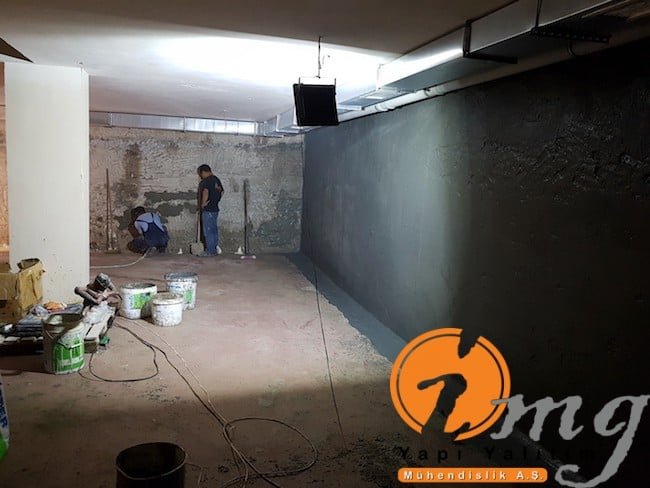
From our Maltepe office we provide anti-mould waterproofing across every district of Istanbul. On-site surveys and application on both the European and Asian sides.
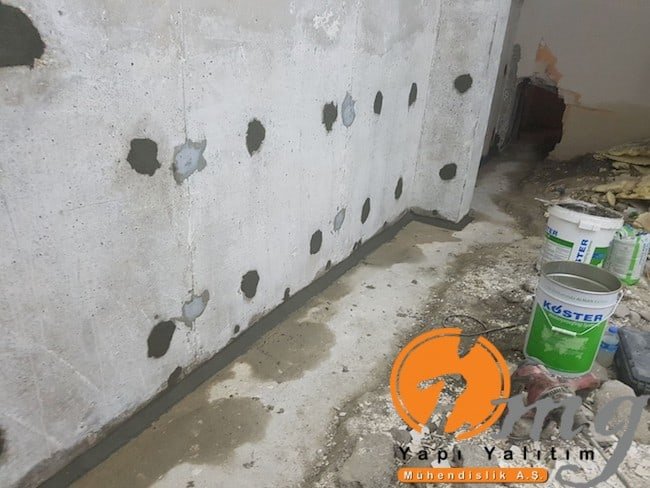
From our Konak office we provide anti-mould waterproofing across every district of Izmir. A wide service network across the Aegean region.
We have compiled the questions our customers ask most often, together with the technical answers.
A permanent cure for chronic damp and moisture in buildings through professional waterproofing works. Moisture source diagnosis and barrier installation.
DetailsA permanent cure for capillary rising damp at ground-floor level using DampStop injection and a crystalline coating.
DetailsMoisture control and indoor air quality improvement in buildings with the Nem Kutusu moisture box system.
DetailsFill in the survey request form or call us about the mould and damp problem in your home or business. Our technical team will get back to you promptly to carry out an on-site moisture source diagnosis and survey.