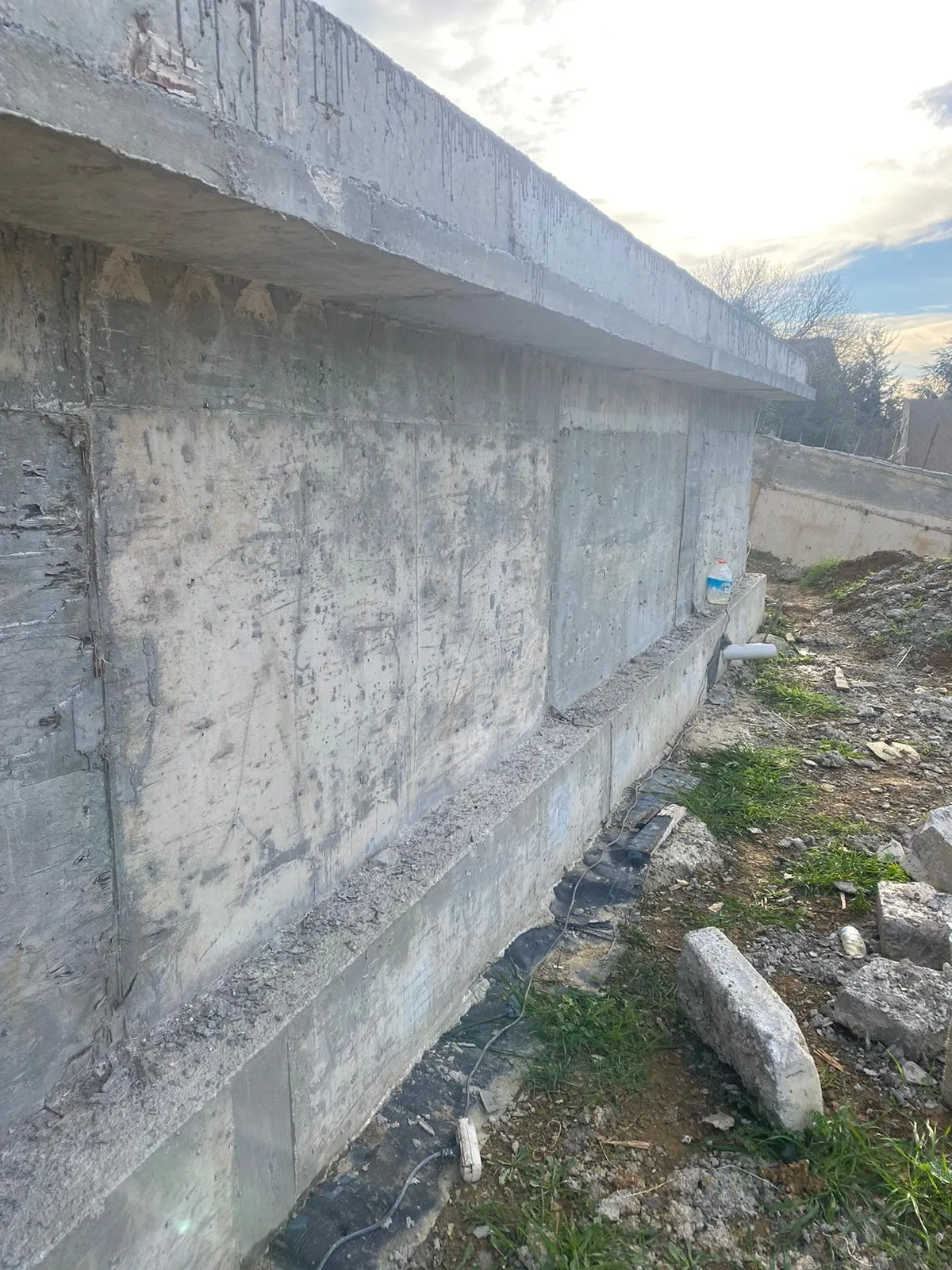
A permanent, 5-year-warranted solution for water leaks, cold joints and segregation-related damp in reinforced concrete retaining walls, using crystalline coatings and resin injection. A specialist team with 15+ years of experience in Istanbul and Izmir.
Retaining wall waterproofing is the structural waterproofing application that protects a building's load-bearing retaining walls against groundwater pressure, cold-joint leakage and segregation-related permeability. In the negative-side method, active cracks and cold joints are first treated with polyurethane resin injection; the entire wall surface is then given a crystalline coating that renders the concrete permanently watertight. A standard application is completed in 2-4 days and comes with a 5-year written warranty.
Retaining wall waterproofing is the structural waterproofing system applied to eliminate water permeability in reinforced concrete retaining walls that are in direct contact with soil and groundwater below ground level. Retaining walls are earth-retaining, load-bearing reinforced concrete elements that run from the building's foundation up to ground level. They play a critical role in transferring building loads to the ground and resisting earth pressure. Concrete, however, is not inherently a watertight material; pores formed during the pour, cold joints, shrinkage cracks and segregation zones all create pathways for water to enter the structure.
With more than 15 years of site experience and its own Dryvatec crystalline coating and injection materials, İMG Yapı Yalıtım Mühendislik A.Ş. delivers permanent waterproofing solutions for reinforced concrete retaining walls using both the negative-side and positive-side methods.
Reinforced concrete retaining walls surround the below-ground part of a building and resist earth pressure as load-bearing elements. When these walls are built, the concrete is usually placed into the formwork in more than one stage. The interfaces left between each pour are known as "cold joints". Because the old and new concrete cannot fully bond at a cold joint, these lines become the most common source of water leakage.
Segregation zones — caused by insufficient vibration during the pour, errors in the water/cement ratio or the accumulation of coarse aggregate — also increase water permeability. In addition, shrinkage cracks that form as the concrete hardens and loses volume widen over time and turn into water entry points. All of these weak points become active leakage zones as the groundwater level rises.
Retaining wall leaks are far more common in areas with a high water table, such as Istanbul and Izmir. In wet periods, rising hydrostatic pressure forces water through every weak point in the concrete. Externally applied membrane or bitumen-based waterproofing installed during construction deteriorates over time due to ground movement, root pressure and mechanical damage. At that point, the only remedy is a professional negative-side or positive-side waterproofing application.
According to research, if the steel reinforcement inside concrete remains in continuous contact with water for 10 years, the bar diameter is reduced by 34% and the load-bearing capacity by 67%. As retaining walls are among a building's primary load-bearing elements, this loss directly threatens the structure's earthquake safety. Permanent structural damage has been identified in 79% of buildings exposed to water damage.
Water seeping through the interfaces between concrete pours placed at different times — horizontal and vertical damp trails running along the wall
Aggregate accumulation zones caused by insufficient vibration, voids within the concrete and permeable areas
Damp patches on the internal face of the wall, white salt deposits (efflorescence) and mould growth that threatens health
Rusting of the steel reinforcement, spalling of the concrete cover, loss of load-bearing capacity and structural safety risk
If you have noticed one or more of the following signs on your retaining walls, a professional waterproofing application is required. Early intervention minimises structural damage and repair costs.
Horizontal damp trails running along the cold-joint line on the wall surface, with active dripping points. They become markedly worse after rainfall and form pooling water.
White, powder-like salt crystals forming on the wall surface. They are conclusive evidence that water is passing through the concrete pores and carrying dissolved minerals to the surface.
Blistering, cracking and spalling of the concrete cover caused by rebar corrosion. This sign indicates advanced structural damage and requires urgent intervention.
Black, green or grey mould patches on the wall surface and at corner junctions. They indicate chronic damp and pose a risk to respiratory health.
A heavy damp smell on entering the space and a permanently moist feel on the wall surfaces. Ventilation alone cannot solve it; the cause itself must be treated.
Vertical water trails on the wall originating from shrinkage cracks. The cracks widen over time, turn into water entry points and require resin injection.
There are two fundamental approaches to retaining wall waterproofing. The right method for each building is determined through an on-site survey.
At İMG Yapı Yalıtım Mühendislik A.Ş.we carry out both methods. During the on-site survey we determine the most suitable method for your building's condition, its surroundings and your budget, and deliver a solution backed by a 5-year warranty.
A systematic application process developed over more than 15 years of site experience, compliant with the TSE EN 1504 standard.
Our specialist team inspects the retaining walls in detail to identify water entry points, cold joints, segregation zones, shrinkage cracks and the distribution of moisture. Surface and depth moisture levels are measured with professional moisture meters. We establish separately which areas of the wall have active leakage and which have capillary damp. Accurate diagnosis is the foundation of a permanent solution; a superficial assessment leads to an incomplete application.
For the crystalline application to succeed, the substrate must be the structural concrete itself. All covering layers on top of it — render, paint, screed, tiles and the like — are completely removed. The surface is mechanically cleaned and dust and loose particles are removed. The concrete face of the retaining wall is exposed and prepared so the crystalline material can penetrate. According to the TSE EN 1504-2 standard, surface preparation is the single most decisive factor in the success of repair applications.
Dryvatec polyurethane or acrylate gel injection material is injected into active water entry points, cold joints and cracks. Injection packers are placed at set intervals along the crack or joint, and the material is injected under pressure with a pump. On contact with water, polyurethane expands to fill the crack and stops the leak immediately. Acrylate gel, with its flexible structure, accommodates movement in the concrete. The injection work must be completed before the crystalline coating is applied.
Dryvatec crystalline waterproofing material is applied in at least two coats to all retaining wall surfaces, floor-wall junctions, corner zones and around service penetrations. The crystalline material penetrates the concrete pores and capillary cracks, forming a needle-like crystalline structure within the concrete. These crystals prevent water from passing through the concrete and create a permanent, self-healing watertight barrier.
After the crystalline application, the surface is wetted at regular intervals to retain moisture and ensure the crystallisation reaction develops optimally. Once the curing period is complete, all wall surfaces are inspected in detail. Suspect areas are tested, and an additional crystalline coat or further injection is applied where needed. All corner fillets and structural repairs are completed.
After the quality inspection, the space is handed back and a 5-year written warranty certificate is issued. The warranty covers all application-related water leakage. If any issue is reported during the warranty period, our team attends site as quickly as possible and intervenes at no charge. Photographs of the application area are archived and your project is kept on record.
For retaining wall waterproofing to be successful and long-lasting, the following technical requirements must be met in full.
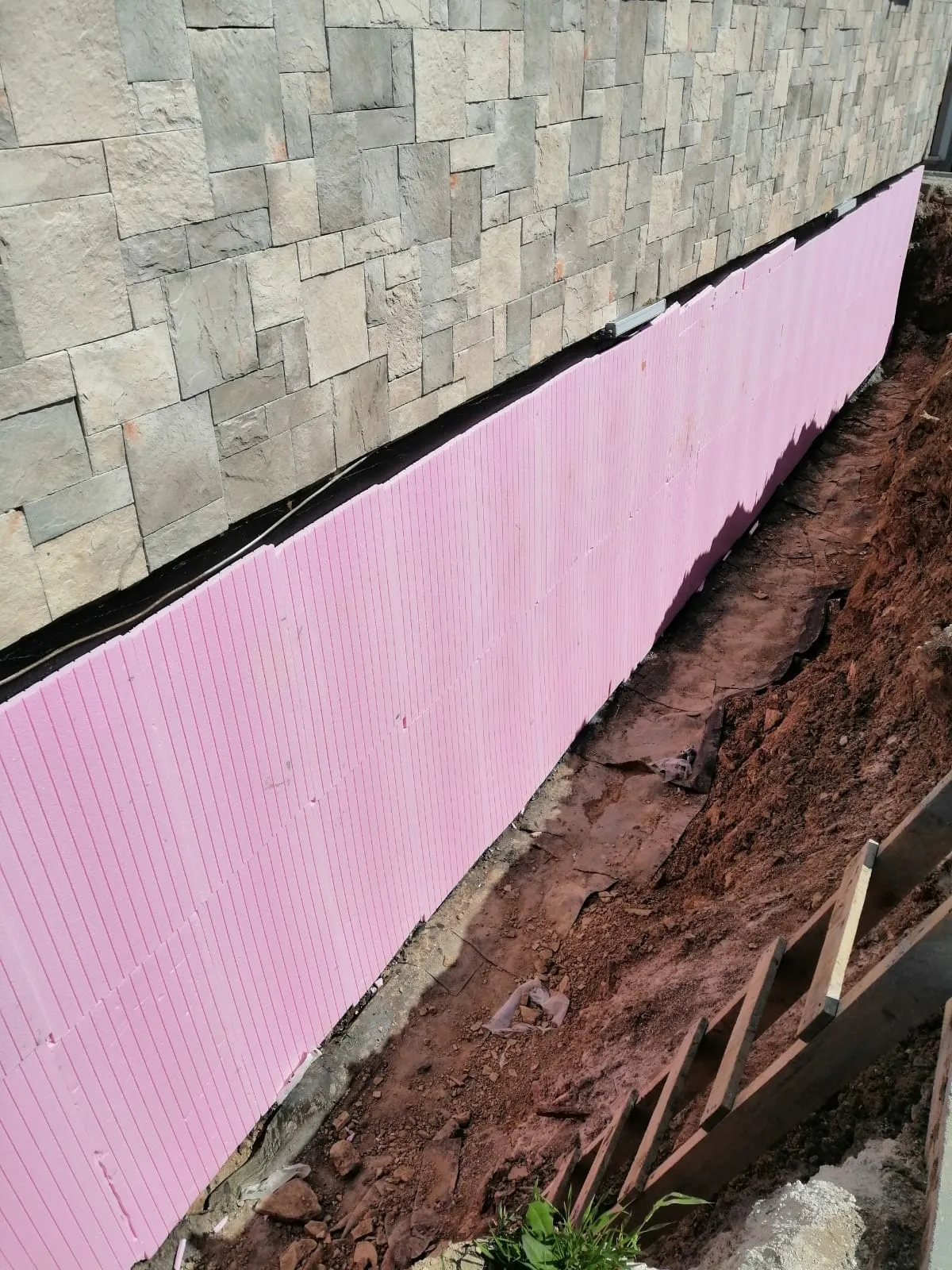
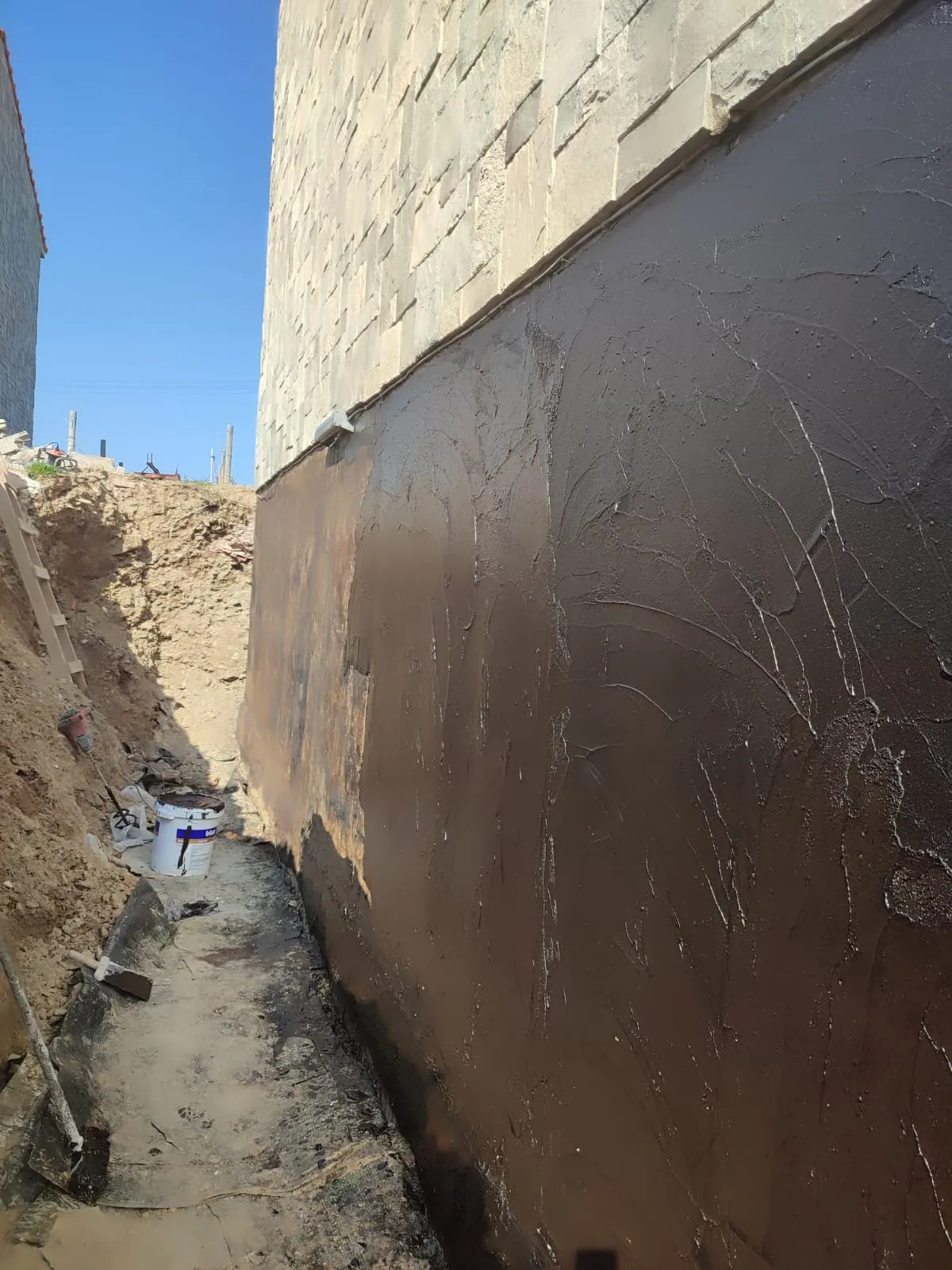
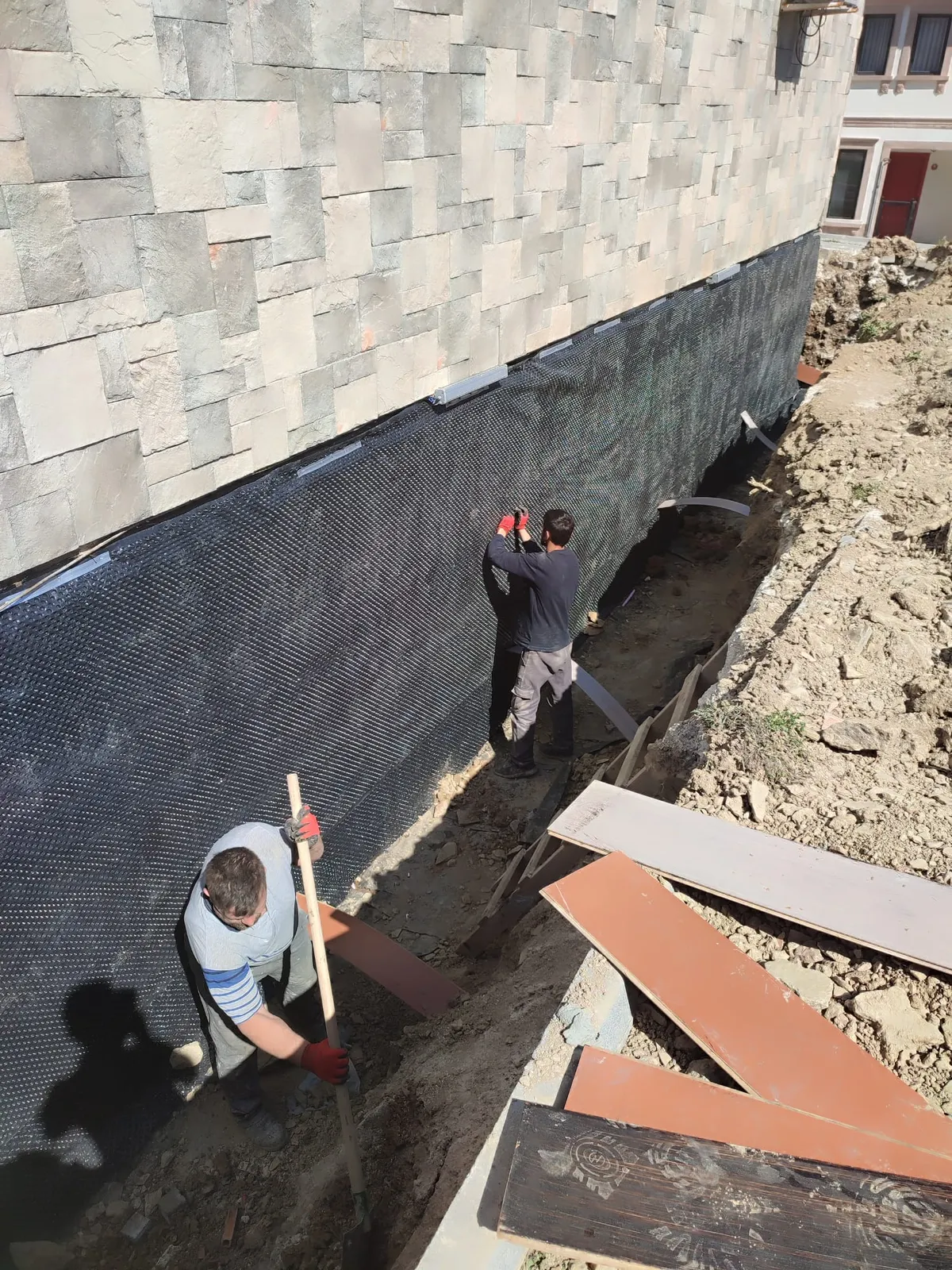
Real application stages from our retaining wall waterproofing projects. Click the photographs to enlarge them.
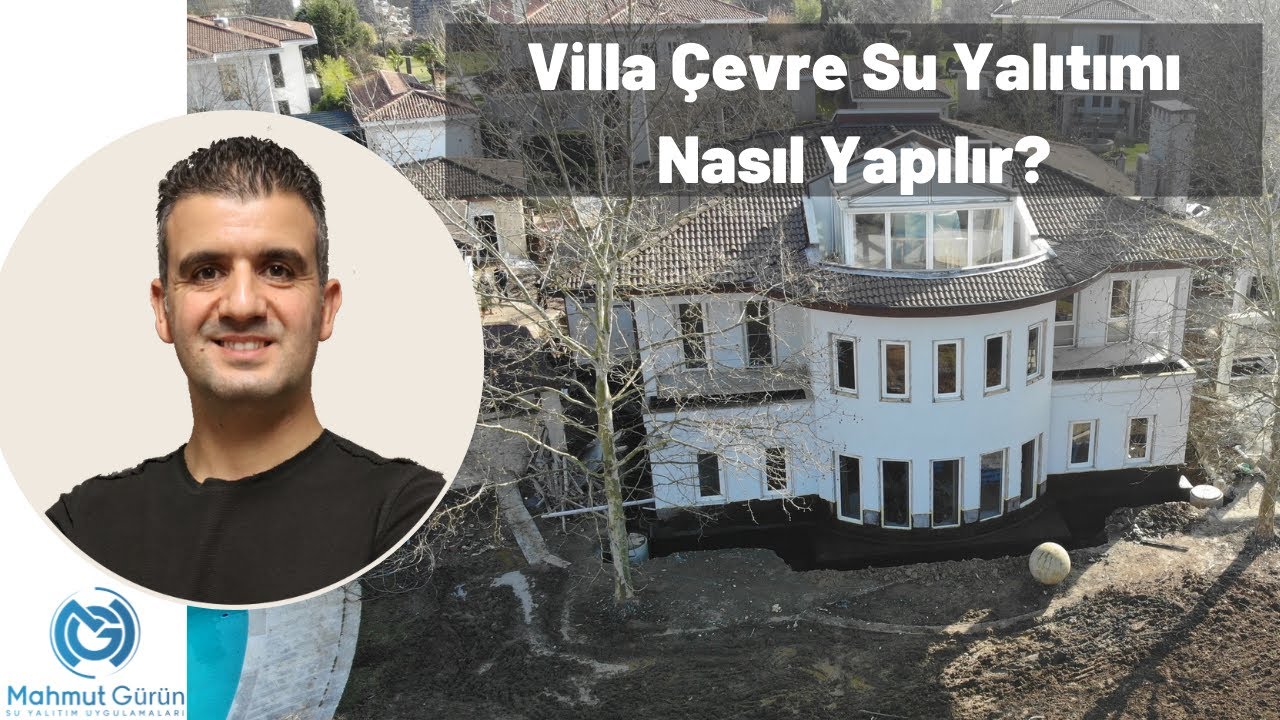
Real site footage and application details.
Retaining walls are part of a building's load-bearing system. The wrong material or a poor application can increase the structural risk instead of solving the problem. Choosing the right contractor is critical.
We issue a 5-year written warranty certificate for every retaining wall application. Any issue covered by the warranty is resolved at no charge. Our application records are archived.
We manufacture the crystalline and injection materials we use ourselves. No middleman margin, and quality control rests entirely with us. Direct manufacturer assurance.
We carry out both methods. We determine the most suitable solution for your building through an on-site survey and offer both excavated and no-dig options.
More than 1,000 completed retaining wall and basement waterproofing projects since 2009. We have delivered solutions for every building type, in every condition and every climate.
Rapid response to every district from our Maltepe (Istanbul) and Konak (Izmir) offices. Local teams and material depots in both major cities.
Rather than covering the problem superficially, we trace it to its root. A detailed survey with moisture meters is the foundation of a permanent solution.
In reinforced concrete retaining wall construction, the concrete is usually placed in more than one stage. On tall retaining walls in particular, a single-stage pour is simply not practical. The second pour is placed after the first has hardened. However, the interface between the two pours cannot form a fully monolithic structure. This interface is known as a "cold joint" and is the most common source of water leakage in retaining walls.
Cold joints generally run horizontally along the retaining wall, and leakage is observed along this line. In the injection process, packers are placed along the joint and Dryvatec polyurethane or acrylate gel is injected under pressure to seal the joint permanently. After injection, a crystalline coating is applied to the entire wall surface to prevent capillary seepage through the concrete pores as well.
The cold joint problem is not confined to older buildings; it is frequently seen in new structures too. Insufficient vibration during construction, long delays between pours or failure to wet the bonding surface are the main causes. With more than 15 years of experience, İMG Yapı Yalıtım Mühendislik provides a permanent solution to cold-joint leaks.
Segregation is the separation of the aggregate (sand and gravel) from the cement paste during a concrete pour. Dropping concrete from height, over-vibration or errors in consistency all cause segregation. In segregated zones, coarse aggregate accumulates while the cement paste flows elsewhere. The result is permeable, honeycombed, weak zones within the concrete.
Under groundwater pressure, these zones become the source of water leakage. Segregation zones must be repaired with structural repair mortar before the crystalline coating is applied. Once the repair mortar is in place, the crystalline coating renders the entire surface watertight. In cases of severe segregation, resin injection may also be required.
At İMG Yapı Yalıtım Mühendislik we specifically look for segregation zones during the retaining wall survey. They are usually concentrated in the lower part of the wall or at points where the concrete drop height was excessive. Accurate diagnosis and proper repair are the foundation of permanent waterproofing.
From our two offices we provide retaining wall waterproofing across every district of Istanbul and Izmir.
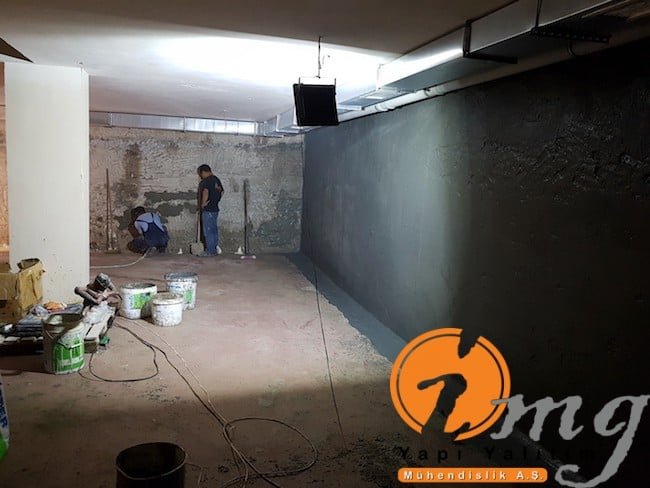
From our Maltepe office we provide retaining wall waterproofing to every district of Istanbul. On-site surveys and applications on both the European and Asian sides.
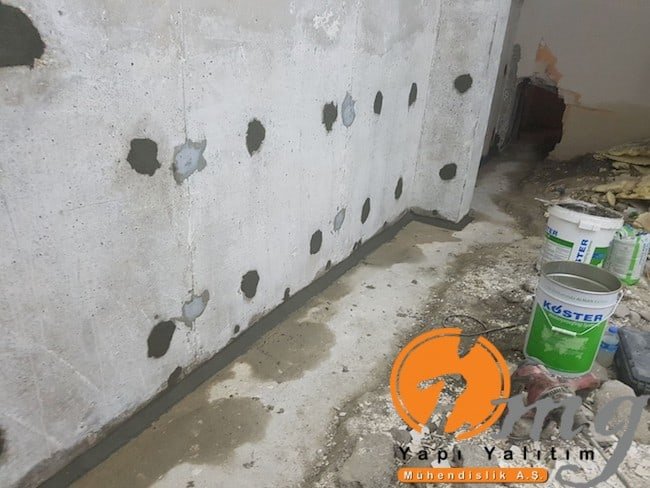
From our Konak office we provide retaining wall waterproofing to every district of Izmir. A wide service network across the Aegean region.
We have compiled the questions our clients ask most often about retaining wall waterproofing, together with our technical answers.
A permanent, no-dig solution to basement water leaks and damp using negative-side crystalline coatings and resin injection.
DetailsStop active water leaks in cracks and joints within minutes using acrylate gel and polyurethane resin injection.
DetailsA permanent solution to leaks at expansion and movement joints using flexible injection and purpose-made profile systems.
DetailsFor water leaks in your retaining walls, fill in the survey request form or give us a call. Our technical team will get back to you as soon as possible to arrange an on-site assessment and survey.