Hygienic, long-lasting waterproofing for potable water tanks, fire-fighting water tanks and industrial water storage using crystalline coatings and epoxy linings. Expert team with 15+ years of experience in Istanbul and Izmir.
Water tank waterproofing is an internally applied lining process that protects potable, domestic and fire-fighting water tanks against water loss, concrete corrosion and loss of hygiene. The tank is drained, cracks and honeycombed areas in the concrete are repaired; a crystalline coating (cementitious tanking slurry) or a food-grade epoxy lining is then applied. All materials used are certified for contact with drinking water. After a fill test the tank is handed over, backed by a 5-year written warranty.
Water tank waterproofing is the technical process of treating the internal surfaces of concrete, reinforced concrete or prefabricated water tanks to prevent water loss and external contamination. In structures of all types — potable water tanks, fire-fighting water tanks, process water tanks and waste water basins — a crystalline coating or an epoxy lining provides hygienic, permanent watertightness.
With over 15 years of site experience and its own Dryvatec-branded materials, İMG Yapı Yalıtım Mühendislik A.Ş. is one of Türkiye's trusted applicators for water tank waterproofing. We deliver a professional service at every scale, from residential apartment tanks to industrial water storage.
Concrete water tanks may look solid and impermeable from the outside, but concrete is not in fact a waterproof material. Every concrete pour creates millions of microscopic pores, and over time water escapes through them. The water level in the tank drops, energy costs rise and the tank becomes less efficient. Even more critically, ground moisture, contaminated water and chemicals can seep into the tank from outside through these same pores and degrade the water quality.
In potable water tanks this is a direct threat to public health. Bacterial colonies and biofilm form easily on unlined concrete surfaces. In warm weather this microbiological growth accelerates and the stored water becomes unfit to drink. According to World Health Organization (WHO) data, inadequate water storage conditions are among the most common causes of waterborne disease.
In fire-fighting water tanks, water loss can mean insufficient capacity in an emergency. Not having enough water in the tank at the moment of a fire is a critical risk that directly threatens life and property. In industrial process water tanks, water loss leads to production stoppages and financial damage.
In the long term, the reinforcement inside an unprotected tank corrodes, the concrete degrades and the tank loses its structural integrity. Research shows that in reinforced concrete structures in constant contact with water, reinforcement bar diameter can shrink by 34% and load-bearing capacity can fall by 67%. This can end with the tank collapsing or becoming unusable.
Water escaping through the pores and cracks of the concrete, a falling water level in the tank and rising energy costs
Bacterial colonies, biofilm and algae growth on rough concrete surfaces; deteriorating water quality
Ground moisture, chemicals and contaminated water seeping into the tank from outside; pollution of the drinking water
Reinforcement corrosion, concrete degradation, reduced load-bearing capacity and loss of structural integrity
Every type of water tank has its own requirements and waterproofing criteria. The most suitable material and method are chosen for each tank type.
Hygienic linings compliant with TSE and food-safety standards for residential, apartment, estate and municipal drinking water tanks. Preserving water quality and preventing bacterial growth is the first priority.
Preventing water loss and preserving capacity in fire water tanks built to fire-safety regulations. A full tank at the moment of a fire is a guarantee of life safety.
Chemically resistant epoxy linings for process water tanks in factories, industrial estates and production plants. Production continuity and water quality are protected.
Chemically and biologically resistant waterproofing for waste water collection basins, septic tanks and treatment plant tanks. Preventing environmental leakage is essential.
Minimising water loss in tanks used for agricultural irrigation. Especially in regions facing water scarcity, saving every drop is economically critical.
Waterproofing of both internal and external surfaces of reinforced concrete tanks mounted on building roofs or terraces. Protection against water loss and the weather.
There are two principal methods for waterproofing a water tank. The most suitable one for the tank type and its intended use is determined by an on-site survey.
At İMG Yapı Yalıtım Mühendislik A.Ş.we apply both methods. Based on your tank's type, the liquid it holds, its intended use and its current condition, we determine the most suitable method through an on-site survey and deliver a solution backed by a 5-year warranty.
A systematic, quality-controlled water tank waterproofing process refined over more than 15 years of site experience.
Our specialist team inspects the tank thoroughly to identify existing leak points, cracks, cold joints, areas of deformation and the condition of the concrete. Where necessary, a concrete sample is taken for compressive strength and water permeability testing. The most suitable waterproofing method is chosen at this stage, based on the tank type, the liquid it holds and its intended use. An accurate survey is the foundation of a successful application.
The tank is fully drained and a temporary water supply is planned. Sediment, limescale, algae and biological growth on the floor and wall surfaces are removed with pressurised water or mechanical methods. The tank is left to dry for a sufficient period and ventilation is provided. In large industrial tanks this stage is carried out with professional submersible pumps and industrial fans.
Concrete surfaces are mechanically cleaned; old coating residues, loose concrete, render remnants and surface contamination are removed completely. Cracks and joints are repaired with structural repair mortar, corners are filleted and the surface is profiled. For a crystalline application the parent concrete must be exposed; for an epoxy application the surface must be brought to the right degree of roughness. Surface preparation directly determines the life of the lining.
Depending on the tank type, Dryvatec crystalline waterproofing material or a food-grade epoxy lining is applied. The crystalline material is applied in at least two coats to all concrete surfaces, floor-wall junctions and corner zones; it penetrates the pores of the concrete and forms a permanent crystalline structure. The epoxy is applied as a multi-layer system of primer, intermediate coat and top coat. In both methods the waiting times between coats are strictly observed.
Once the lining has completed its curing period, the tank is filled completely with water and the water level is monitored for at least 72 hours. If any drop in the level is detected, the affected area is identified, an additional coat or repair is carried out and the test is repeated. The fill test is an integral part of handover and proves the success of the application with hard data. The test results are documented in a written report.
Once the fill test has been passed, the tank is handed over ready for use and a 5-year written warranty certificate is issued. The warranty covers any water leak or lining failure arising from the application. If any problem is reported during the warranty period, our team attends site as quickly as possible and remedies it free of charge. Photographs of the application area and the test reports are archived.
For water tank waterproofing to be successful and long-lasting, the following technical requirements must be met in full.
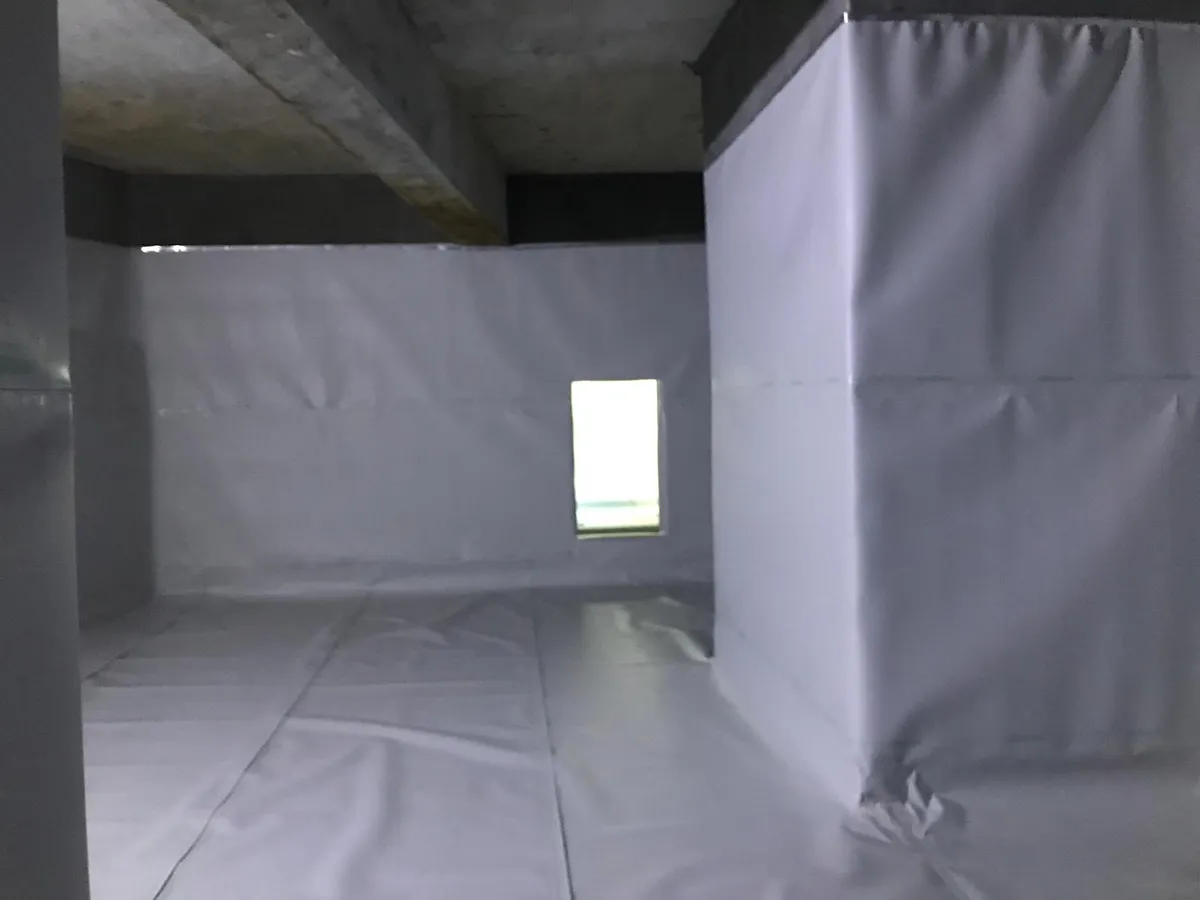
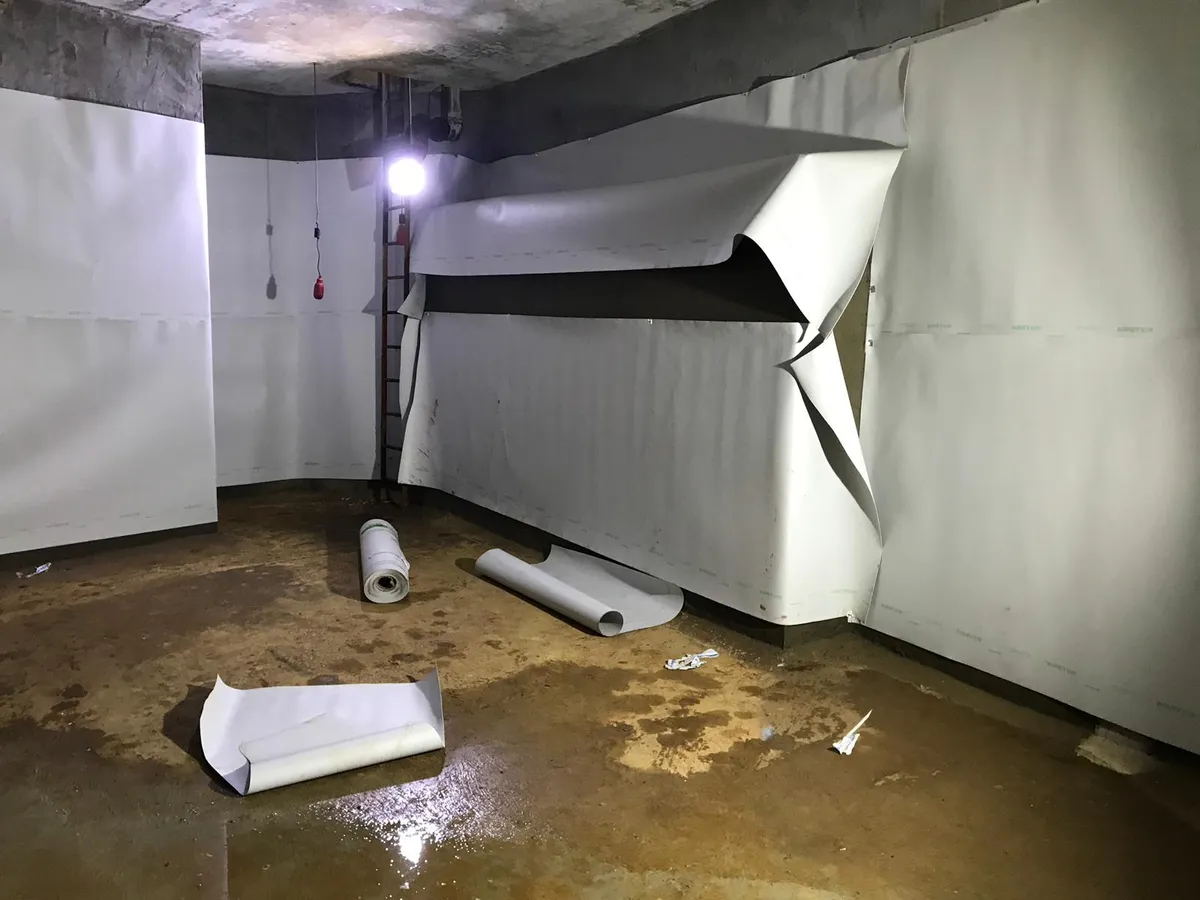
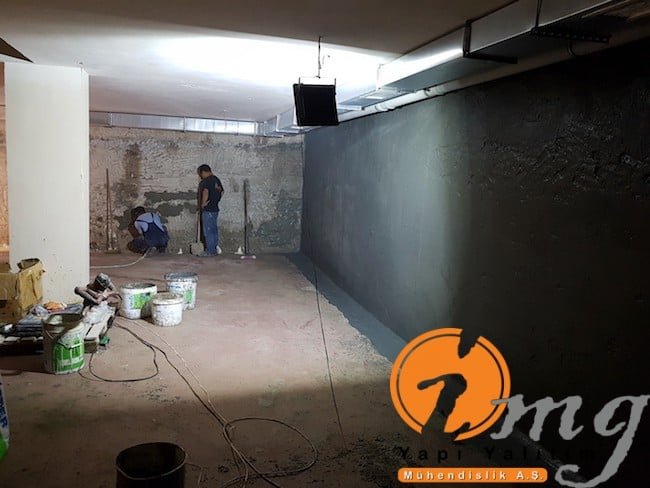
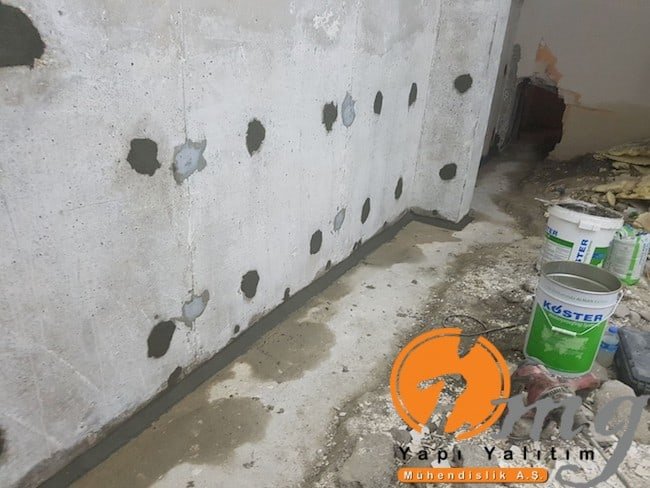
Real application stages from our water tank waterproofing projects. Click the photos to enlarge.
In water tank waterproofing applications we use the crystalline coating material of our own brand, Dryvatec, together with TSE-compliant epoxy lining systems. Because we manufacture the material ourselves, quality control is in our hands from start to finish. There is no middleman margin — you get a direct manufacturer's assurance.
The Dryvatec crystalline material used in potable water tanks penetrates the pores of the concrete to form needle-like crystals and is hygienic, posing no risk to human health on contact with water. Our epoxy lining system, preferred for industrial tanks, offers chemical resistance, mechanical strength and a long service life. Both product ranges are manufactured to TSE EN standards.
Visit our YouTube channel for real site footage and application details.
The wrong material or a faulty application can create bigger problems instead of solving them. Water tanks are critical structures for hygiene and safety.
Every water tank application comes with a 5-year written warranty certificate. Any issue covered by the warranty is resolved at no cost. Our application archives and fill test reports are kept on record.
We manufacture the crystalline and epoxy materials we use ourselves. No middleman margin — quality control is entirely in our hands. Direct manufacturer's assurance and full material traceability.
In potable water tanks we use certified materials compliant with TSE and food-safety standards. Our hygienic application protocols protect water quality.
Since 2009 we have completed water tank waterproofing projects at every scale, from residential tanks to industrial storage. We have delivered solutions for every tank type and every condition.
We carry out a 72-hour fill test on every project. No project that fails the test is handed over. The results are reported in writing and archived.
Rapid response to every district from our Maltepe (Istanbul) and Konak (Izmir) offices. Local teams and material depots in both major cities.
From our two offices we provide water tank waterproofing across every district of Istanbul and Izmir.
From our Maltepe office we provide water tank waterproofing across all districts of Istanbul. On-site surveys and applications for residential, commercial and industrial water tanks.
From our Konak office we provide water tank waterproofing across all districts of Izmir. A wide service network throughout the Aegean region.
We have compiled the questions our clients ask most often, together with our technical answers.
Permanent, hygienic waterproofing for swimming pools using crystalline coatings and epoxy systems.
DetailsMake concrete permanently watertight with a crystalline admixture added at the point of pouring.
DetailsStop active water leaks in cracks and joints within minutes using acrylate gel and polyurethane resin injection.
DetailsFor a leak, water loss or hygiene problem in your water tank, fill in the survey request form or give us a call. Our technical team will get back to you as soon as possible to arrange an on-site assessment and survey.