Make your concrete watertight at the molecular level with capillary crystallisation technology. Permanent impermeability with integral admixture and surface application options. An expert team with 15+ years of experience in Istanbul and Izmir.
A crystalline waterproofing admixture is a chemical material added to the mix at the pouring stage or brush-applied to hardened concrete surfaces. It reacts with compounds in the cement to grow needle-like crystals inside the pores and hairline cracks, making the concrete permanently watertight — the principle behind BS 8102 Type B (structurally integral) protection. In integral application it is dosed at 1-2% of the cement weight; in surface application, consumption is calculated at 1.0-1.5 kg per m². A minimum 72-hour curing period is required.
A crystalline waterproofing admixture is a special chemical waterproofing material that is either added integrally to the concrete mix or applied as a coating to existing concrete surfaces. Its active chemical compounds react with the moisture and calcium hydroxide (free lime) within the concrete to form insoluble, needle-like crystal structures inside the capillary pores, micro-cracks and voids.
These crystals permanently seal the internal structure of the concrete. Unlike traditional membrane or coating systems, it turns the concrete itself into the waterproofing barrier. There is no separate protective layer on the surface; watertightness is achieved within the body of the concrete, at the molecular level — the approach classified as Type B (structurally integral) protection under BS 8102.
With more than 15 years of site experience and its own Dryvateccrystalline product range, İMG Yapı Yalıtım Mühendislik A.Ş. is one of Türkiye's leading applicators in this field.
A crystalline waterproofing admixture works by exploiting the natural chemistry of concrete. The calcium hydroxide (Ca(OH)₂ — free lime) released during cement hydration acts as the primary reactant for the active compounds of the crystalline admixture. When the admixture comes into contact with moisture inside the concrete, it reacts chemically with this free lime to form insoluble crystal structures within the capillary pores and micro-cracks.
The crystals have a needle-like morphology and become a natural part of the concrete matrix. They physically block water from travelling through the concrete by capillary action. Providing watertightness at pressures of up to 12 bar (roughly a 120-metre head of water), this structure remains active for the life of the concrete. Every time water makes contact, the crystallisation reaction restarts; the system is therefore not a passive layer but a dynamic protection mechanism.
The most remarkable property of the crystalline admixture is its self-healing capability. In fine cracks of up to 0.4 mm that develop in the concrete over time, the water entering the crack reacts again with the crystalline compounds and forms new crystals that seal the crack automatically. This property fundamentally sets the crystalline admixture apart from traditional waterproofing methods.
The porous structure of concrete is normally seen as a weakness; the crystalline admixture turns those pores into an advantage. Every pore becomes a crystallisation site and the density of the concrete increases. Chloride ion permeability falls by up to 40%, reinforcement corrosion is delayed, freeze-thaw resistance improves and the overall service life of the concrete is significantly extended.
The crystals form within the internal structure of the concrete; there is no separate layer on the surface. Immune to mechanical damage — it cannot be punctured or torn.
Impermeability up to a 120-metre head of water. Full protection against groundwater, hydrostatic pressure and negative-side water pressure.
Seals itself through automatic crystallisation in cracks up to 0.4 mm. Remains active for the life of the concrete.
Effective against both positive-side and negative-side water pressure. Unlike membranes, it does not depend on which side the water comes from.
The crystalline waterproofing admixture can be applied in several ways. Choosing the right method for the condition of the structure directly affects the success of the project.
In new concrete pours the crystalline admixture is added to the mix at the batching plant. It is dosed at 1-2% of the cement weight. While the concrete is still fresh, the admixture disperses homogeneously and crystallisation begins during hydration. This method is preferred especially in new builds, water tank pours and foundation retaining wall concrete. The entire concrete becomes watertight from the outset.
On existing structures it is applied to the concrete surface by brush, trowel or spray. It is applied in at least two coats at a consumption of 1.0-1.5 kg per square metre. The crystalline material penetrates the concrete pores and forms the crystal structure within. This method can be used without excavation on existing basements, water tanks, pool shells and every kind of reinforced concrete structure.
While the surface of freshly poured concrete is still workable, the crystalline powder is broadcast over it and embedded into the concrete with a power trowel. It is preferred especially for large ground slabs, industrial floors and car park slabs. It offers fast application and a high surface density.
The crystalline admixture is added to concrete repair mortars, joint fillers and render mixes to achieve local watertightness. It is used at critical details such as construction joints, crack repairs, pipe penetrations and junctions. As a complement to the main application, it is of great importance.
A technical comparison of the crystalline admixture and traditional membrane systems. Review the key differences to determine the most suitable method for your project.
At İMG Yapı Yalıtım Mühendislik A.Ş. we recommend the most suitable of the crystalline admixture, membrane or combined solutions according to the conditions of your project. After an on-site survey and technical analysis, we prepare a solution plan tailored to your building.
The systematic crystalline waterproofing admixture application process we have developed over more than 15 years of site experience.
The current condition of the structure, the concrete class, the environmental conditions, the groundwater level and the degree of water pressure are analysed in detail. On existing structures, surface and depth moisture are measured with moisture measurement instruments. On new builds, the project drawings and the concrete mix design are reviewed. The crystalline product type and application method suited to the project (integral, surface coating or dry-shake) are determined at this stage.
The crystalline admixture dosage is calculated project by project according to the concrete class, the level of water pressure, the intended use of the structure and the environmental conditions. In integral application it is set at 1-2% of the cement weight; in surface application, consumption of 1.0-1.5 kg per square metre is allowed for, with an increased dosage in critical areas. An incorrect dosage directly affects both performance and cost, so a technical calculation is essential.
In integral application the crystalline admixture is added to the mix at the batching plant and a homogeneous dispersion is achieved. In surface application the concrete surface is first cleaned mechanically; render, paint and all covering layers are removed to expose the parent concrete. The crystalline material is then applied to the prepared surface in at least two coats by brush or spray. The specified waiting time between coats is observed. All corner junctions, construction joints and pipe penetrations are reinforced with dedicated detail applications.
To allow the crystalline material to form its crystal structure within the concrete pores, the surface is kept damp for a minimum of 72 hours after application. The surface is wetted at regular intervals to ensure the optimal development of the crystallisation reaction. In cold weather the curing period can be extended to up to 5 days. The curing process is the most decisive step in the success of a crystalline application; insufficient curing leads to incomplete crystallisation and reduced performance.
After the curing period, watertightness tests are carried out. Surface and depth impermeability are verified with professional moisture measurement instruments. On surface applications a water-holding test is performed to observe whether any water passes through over a set period. Additional crystalline coats are applied in areas where they are deemed necessary. All test results are documented and added to the project archive.
Once all tests have been completed successfully, the project is handed over and a written warranty certificate is issued. Under the warranty, any recurrence of water permeability caused by the application is remedied at no charge. Photographs of the application area, test results and technical reports are archived. Should any issue be reported during the warranty period, our team attends the site as soon as possible.
For a crystalline waterproofing admixture treatment to be long-lasting and successful, the following technical requirements must be met in full.
The crystalline waterproofing admixture delivers an effective, permanent solution in every type of structure where concrete is in contact with water.
Potable water tanks, fire-water tanks and industrial water tanks. With the health-certified crystalline admixture, permanent impermeability with no transfer of toxic substances into the water. The safest waterproofing method for potable water structures.
Pool shells, overflow channels and plant rooms. With the crystalline admixture, the entire pool concrete becomes watertight. A permanent alternative to the puncture and ageing risks of membranes.
Foundation retaining walls, basement floor slabs and wall-floor junctions. A capillary impermeability barrier against groundwater that works in both the positive and the negative direction.
Metro tunnels, infrastructure underpasses, sewerage structures and bridge piers. In structures operating under high water pressure, the crystalline admixture provides impermeability up to 12 bar.
Treatment plants, chemical containment basins and industrial floors. With the crystalline admixture enhancing chemical resistance, the concrete is protected against acid and sulphate attack.
Open and covered car park decks, large ground slabs and ramp structures. Fast application and high surface density with the dry-shake method. Protection against salt and chemical attack.

In crystalline waterproofing admixture applications we use the crystalline admixture, crystalline coating and crystalline repair mortar products of our own brand, Dryvatec. Because we manufacture the material ourselves, quality control is in our hands from start to finish. We serve with a direct manufacturer's assurance, with no intermediary margin.
The Dryvatec crystalline product range covers every application method with integral admixture, surface coating, dry-shake and repair mortar options. All products are manufactured in accordance with TSE EN standards. A health-certified crystalline product option is available for potable water structures.
Watch real site footage and application details on our YouTube channel.
The technical and economic advantages the crystalline waterproofing admixture offers over traditional waterproofing methods.
The crystalline structure remains active for the life of the concrete. It does not need renewal every 10-15 years like membranes. Once applied, the crystalline admixture becomes a permanent part of the concrete and no re-application is required.
It repairs itself in fine cracks up to 0.4 mm. Water entering the crack reacts again with the crystalline compounds and forms new crystals. Maintenance-free, continuous protection. No traditional waterproofing system offers this property.
Effective against both positive-side (the water side) and negative-side (the opposite side) water pressure. Unlike membranes, there is no application-side restriction. In basements, water tanks and tunnel structures, this property is a critical advantage.
While the initial application cost is comparable to a membrane, maintenance and renewal costs are close to zero. It delivers savings of 30-50% in the 20-year total cost of ownership (TCO). Labour costs are also lower.
By filling the pores with crystals, the admixture increases the density of the concrete. It cuts chloride ion permeability by 40%, delaying reinforcement corrosion. It improves freeze-thaw resistance and increases resistance to chemical attack.
An environmentally friendly formulation, unlike bitumen- or PVC-based membranes. It can be used safely in potable water structures. It does not hinder the recycling of the concrete. There are no harmful gas emissions during application.
The performance of a crystalline admixture depends on the dosage calculation, the quality of the application and the correct management of the curing process. This is where an expert team and quality materials make the difference.
We hand over a written warranty certificate on all our crystalline applications. Under the warranty, every issue is resolved at no charge. Our application archives are kept on record.
We manufacture the crystalline admixture and coating materials we use ourselves. No intermediary margin — quality control is entirely in our hands. A direct manufacturer's assurance.
We prepare a project-specific dosage and application plan. We calculate the optimal crystalline admixture quantity according to the concrete class, the water pressure and the intended use.
Crystalline admixture applications in water tanks, pools, basements and industrial structures since 2009. We have delivered solutions in every structure type and every condition.
Rapid response to every district from our Maltepe (Istanbul) and Konak (Izmir) offices. Local teams and material depots in two major cities.
Watertightness tests are carried out after application and the results are documented. The project archive, photographs and technical reports are handed over.
From our two offices we provide crystalline waterproofing admixture services to every district of Istanbul and Izmir.
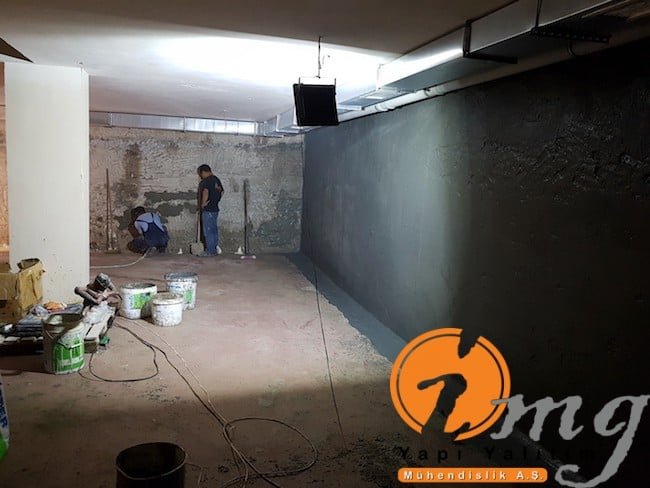
From our Maltepe office we provide crystalline waterproofing admixture services to every district of Istanbul. On-site surveys and applications on both the European and the Asian side.
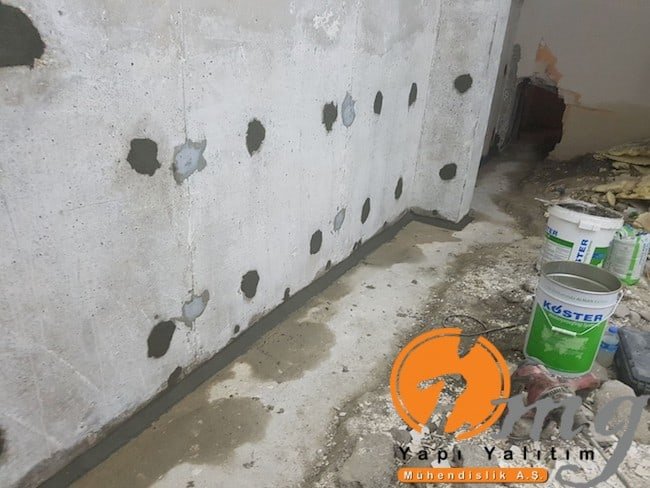
From our Konak office we provide crystalline waterproofing admixture services to every district of Izmir. A wide service network across the Aegean Region.
We have compiled the questions our customers ask most, together with our technical answers.
A permanent solution to basement water ingress with no-dig negative-side crystalline tanking and acrylate gel injection.
DetailsHealth-certified, permanent watertightness in potable water and fire-water tanks with the crystalline admixture.
DetailsPermanent waterproofing of pool shells, overflow channels and plant rooms with crystalline admixture and coating.
DetailsLet us determine the most suitable crystalline waterproofing admixture solution for your building. Fill in the survey request form or give us a call. Our technical team will get back to you as soon as possible for a project assessment and site survey.