You do not have to dig out the soil to reach the back of a basement wall. We drill right through the wall and inject acrylate gel against its outer face. The gel bonds with the soil and stops the water before it ever reaches the wall. The whole job is done from inside, and the building stays in use.
Curtain injection forms a water-stopping gel layer behind a basement wall that is buried in the ground. The RC retaining wall is drilled right through on a 30–50 cm grid, injection packers are fitted in the holes, and Dryvatec G101 acrylate gel is injected at the lowest workable pressure, starting from the bottom row. The gel combines with the soil and water behind the wall and cures within minutes. No excavation, no opening up of the façade: the water is stopped on the positive side, before it reaches the structure.
In a building with a basement buried in the ground, the right place for waterproofing is the outer face of the wall, applied while the building is being built. When water starts coming through later, the only way to reach that face is usually excavation: the garden is dug up, you have to enter the neighbouring plot, sometimes a road has to be opened. In a city this is often impossible, or it costs more than the waterproofing itself.
Curtain injection solves this from the inside. Acrylate gel injected through holes drilled right through the wall mixes with the soil and the water behind it and turns into a flexible layer. In section, this layer looks like a thin curtain stuck to the outer face of the wall, which is where the method gets its name. So although we work from inside, the water is stopped on the positive side of the wall, which is where it should be stopped.
This is how it differs from coatings applied from inside. Crystalline coatings also work, but they stop the water inside the concrete and the wall stays wet. With curtain injection the aim is that the water never reaches the concrete at all. The two can also be combined: gel first, then Dryvatec N102 Crystal 2K as an option.
At the survey we first look at where the water comes from and how. If one of the cases below applies, curtain injection is a strong candidate.
If water is not coming from a single crack but seeping through the whole wall, or through several cold joints, spot injection is not enough. The whole surface needs a grid.
A neighbouring building, a road, a car-park ramp or the landscaping makes it impossible, or far too expensive, to get down to the outer face of the wall.
The slab-to-wall junction, the cold joint between two pours and the formwork tie holes are typical water paths. The gel seals these lines from behind as well.
In a basement used as storage, a car park, a plant room or business premises, the work is done section by section and the space is not emptied.
Where water is flowing fast under pressure, we stop it first with E101 Pur In. If there is structural damage, reinforcement corrosion or a structural defect, that comes first; injection does not solve those.
The drawing below is our D-06 application detail. In the section the soil side is on the left and the inside of the basement on the right. Click the image to enlarge it.
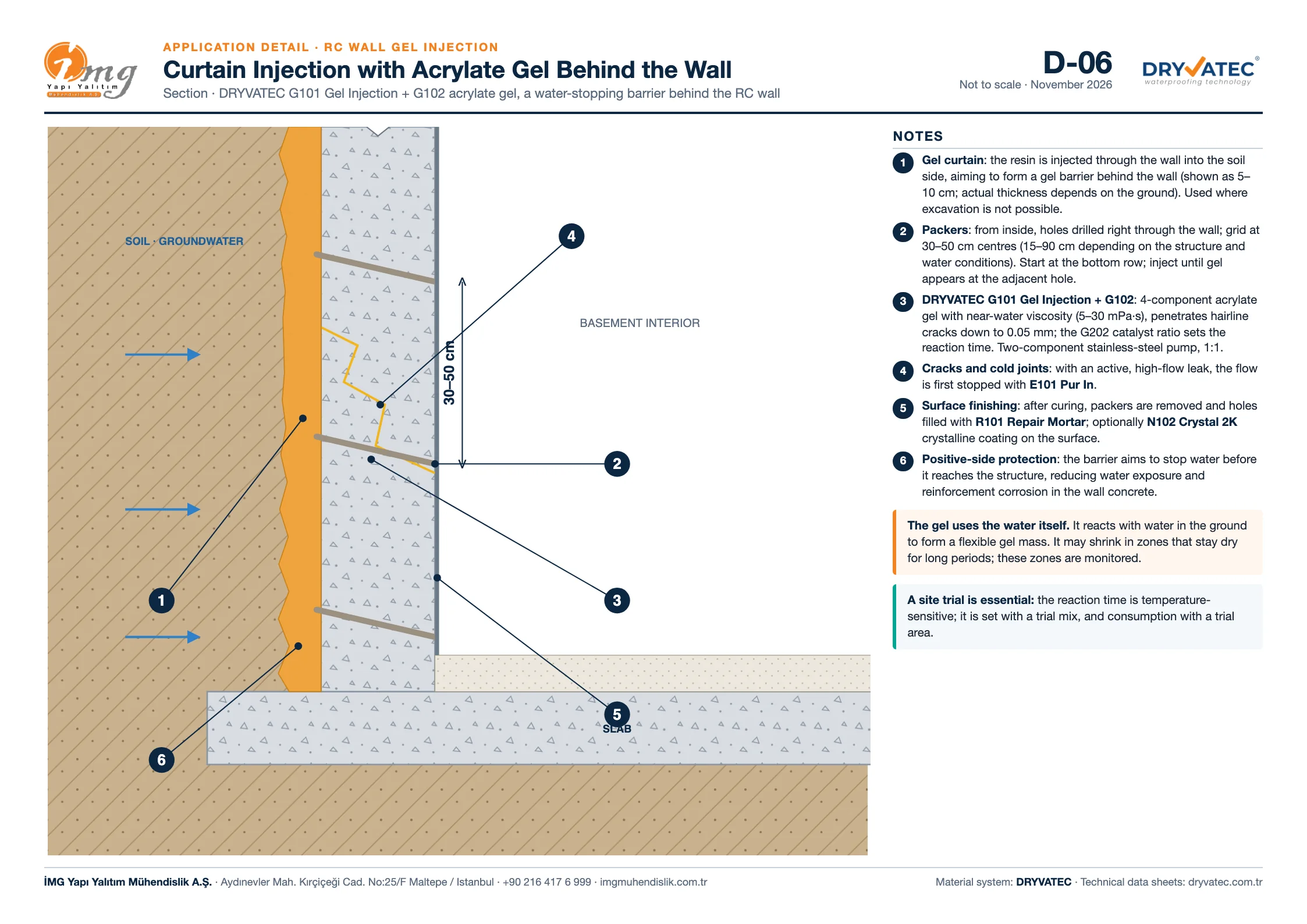
Reinforced concrete retaining wall buried in the ground. The holes pass right through the wall and reach the soil behind it.
The injection nozzle expanded into the hole. 30–50 cm grid, adjusted between 15 and 90 cm depending on the ground.
The gel layer that bonds with the soil on the outer face of the wall. The 5–10 cm thickness shown in the section is illustrative.
Packer holes are filled with R101; optionally N102 Crystal 2K up to ceiling level.
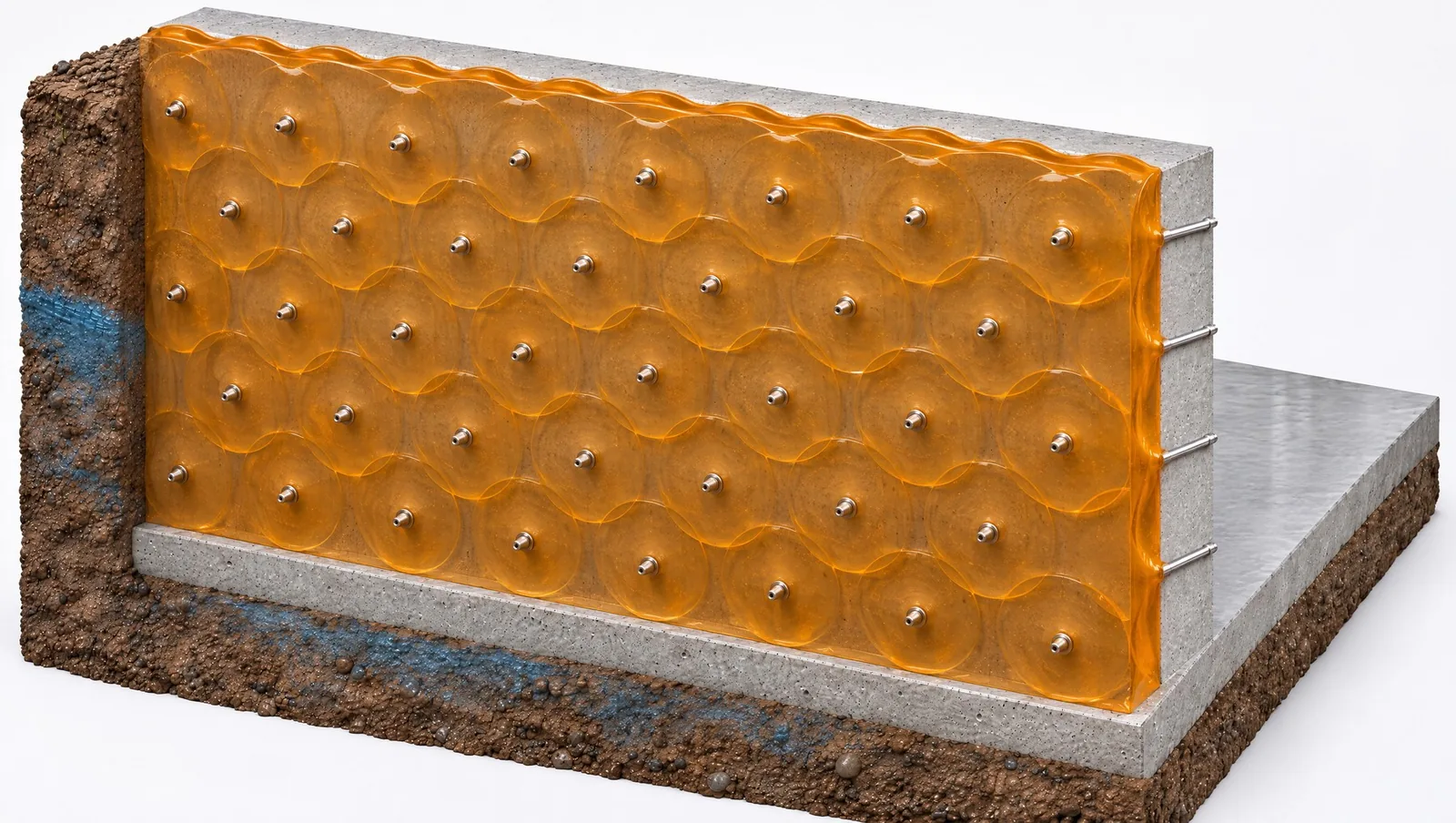
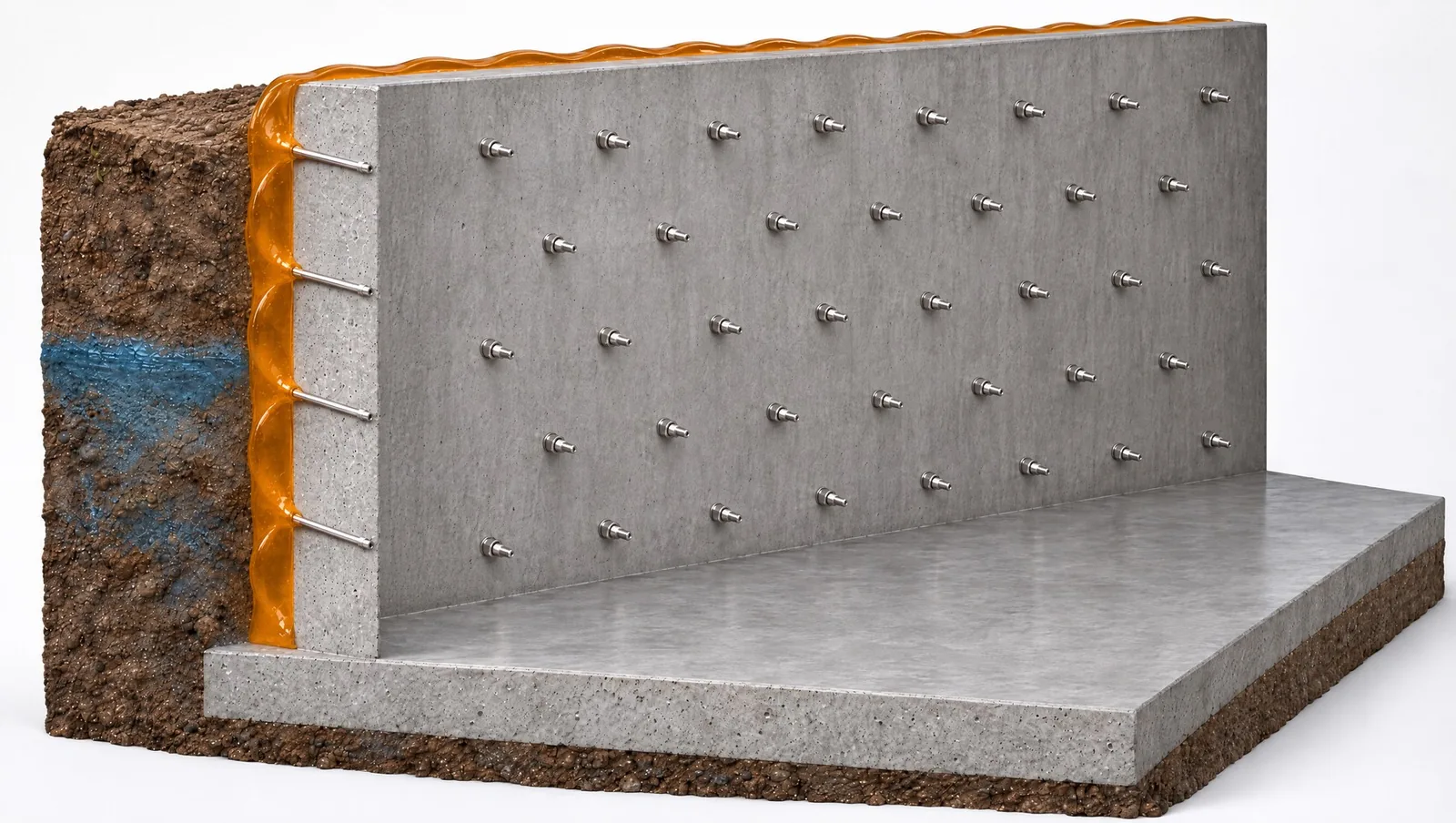
This is the sequence we follow on site. The drawings are taken from the application steps of the D-06 detail.
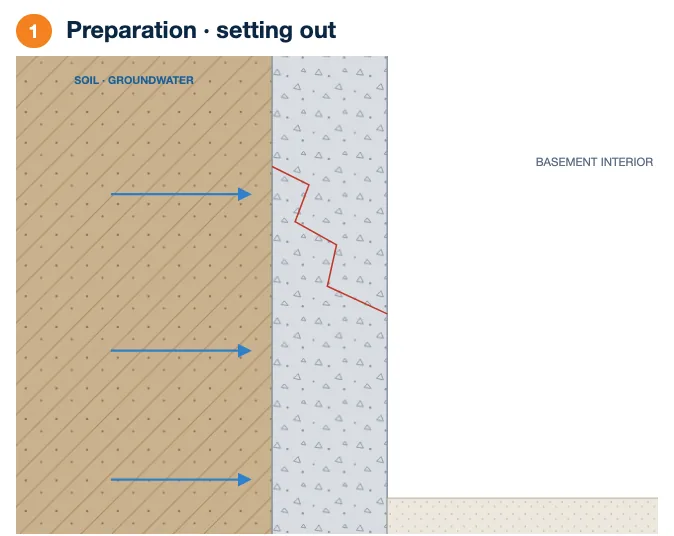
Plaster and finishes are removed from the wall down to bare concrete, so the packer sits on sound concrete. The reinforcement is scanned and a 30–50 cm staggered grid is marked over the whole wet area. If there is a leak running under pressure, the water is stopped first with E101 Pur In.
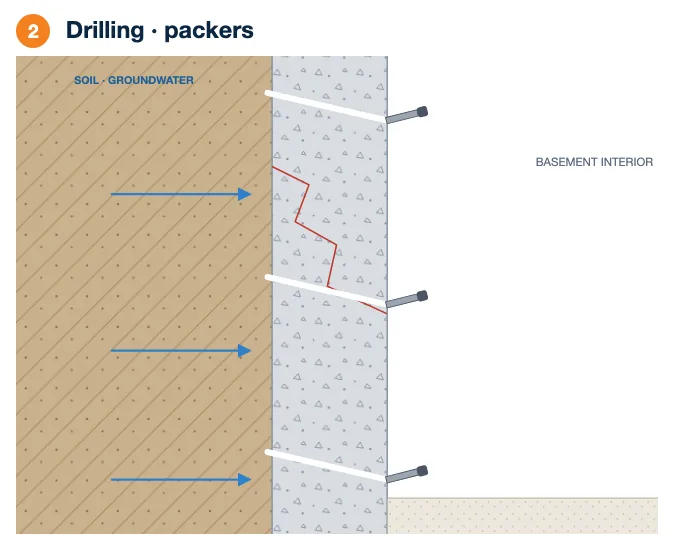
Holes are drilled square to the wall, right through it until they reach the soil behind. The dust is blown out with compressed air and the packers are fixed tightly in the holes.
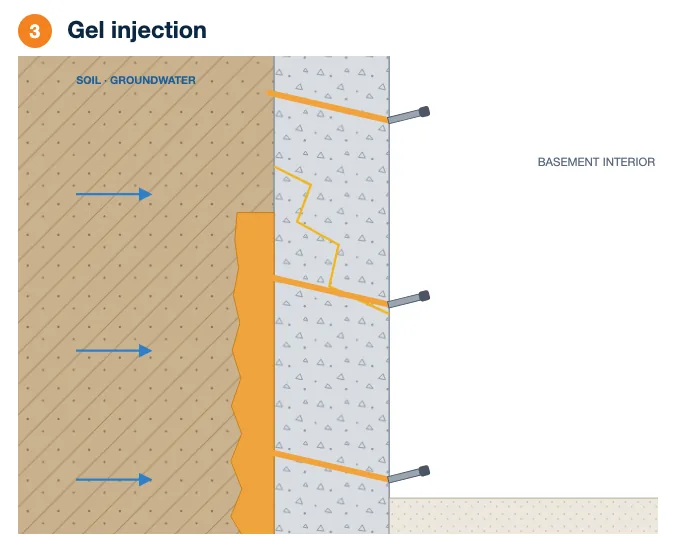
The two mixes are prepared in separate buckets and the reaction time is measured in a trial cup. G101 + G102 is injected at 1 : 1 with a two-component stainless-steel pump. We start from the bottom row, work at the lowest pressure, and move to the next packer when gel appears at the neighbouring one.
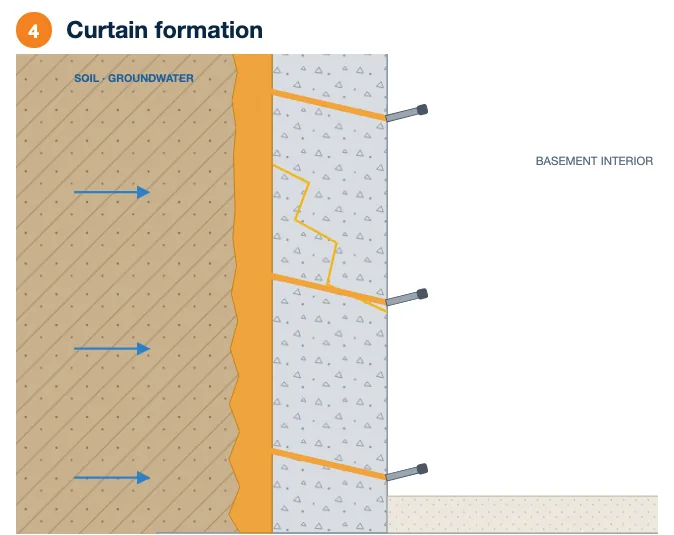
The gel cures within minutes. The aim is for it to combine with the soil and water behind the wall and form a continuous layer. We check packer by packer that the leak has stopped.
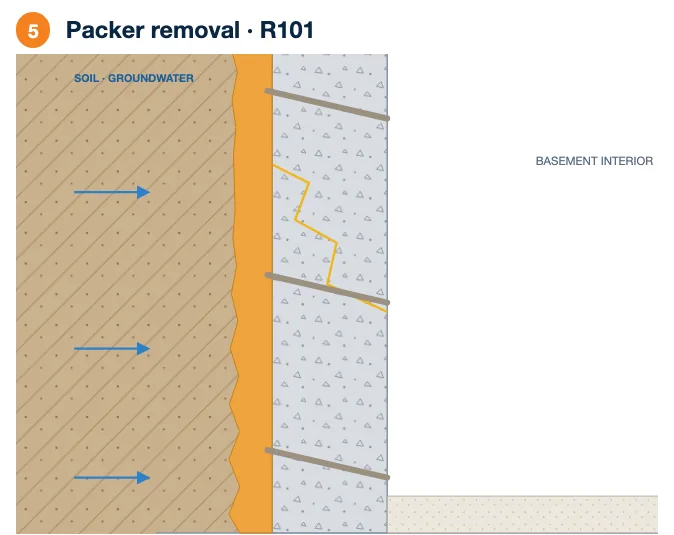
When curing is complete the packers are removed and the holes are filled with R101 Repair Mortar. If any area is still damp, we occasionally drill extra holes there.
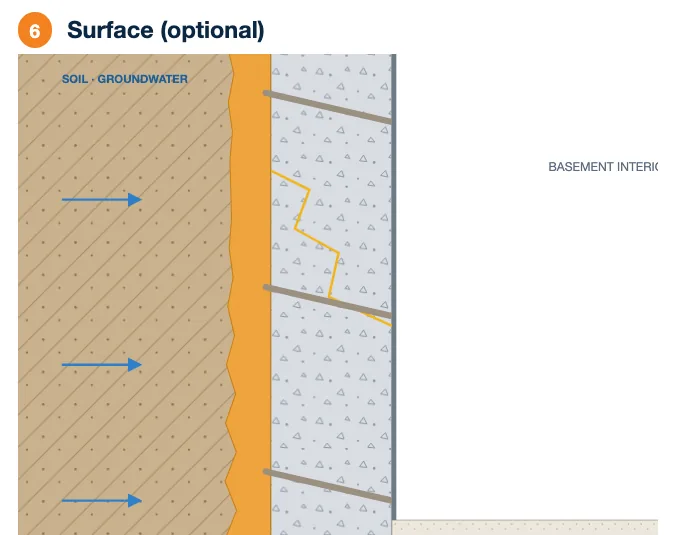
If you want a smooth inner surface with a second layer of protection, N102 Crystal 2K is applied from floor to ceiling. Plaster and paint can follow.
The application dimensions are specific to this method; the material values come from the Dryvatec G101 technical data sheet.
| Item | Value |
|---|---|
| Packer grid | 30–50 cm staggered (15–90 cm depending on the ground) |
| Hole depth | Right through the wall, reaching the soil |
| Injection sequence | Bottom to top, row by row |
| Move-on criterion | Gel appearing at the neighbouring packer |
| Property | Value |
|---|---|
| Viscosity | 5–30 mPa·s, close to water |
| Crack width it can enter | 0.05 mm – 4 mm |
| Mixing | Two mixes, 1 : 1 by volume, with a two-component pump |
| Reaction (gel) time | About 35 seconds to 24 minutes, set by the G202 ratio |
| Pump pressure | 5–100 bar; always start at the lowest workable pressure |
| Minimum application temperature | +2 °C |
| Density / pH | 1.15–1.20 g/cm³ / 6–7.5 |
| Flammability | Non-flammable; water-based |
| G202 ratio | Gel time |
|---|---|
| 0.15% | ≈ 11 minutes |
| 0.5% | ≈ 3.5 minutes |
| 1% | ≈ 1.7 minutes |
| 2% | ≈ 1 minute |
| 4% | ≈ 35 seconds |
| Mix | Liquid | Where |
|---|---|---|
| A — Standard | 20 kg water | Static cracks, porous concrete, the body of a stone wall |
| B — Fully flexible | 20 kg G102 | Moving cracks and expansion joints |
| C — Semi-flexible | 10 kg G102 + 10 kg water | Cases in between; chosen after a trial on site |
Reaction times are laboratory values. On site, cold water lengthens them and hot weather shortens them, so every job starts with a cup test. The G201 / G202 catalyst is part of the four-component system.
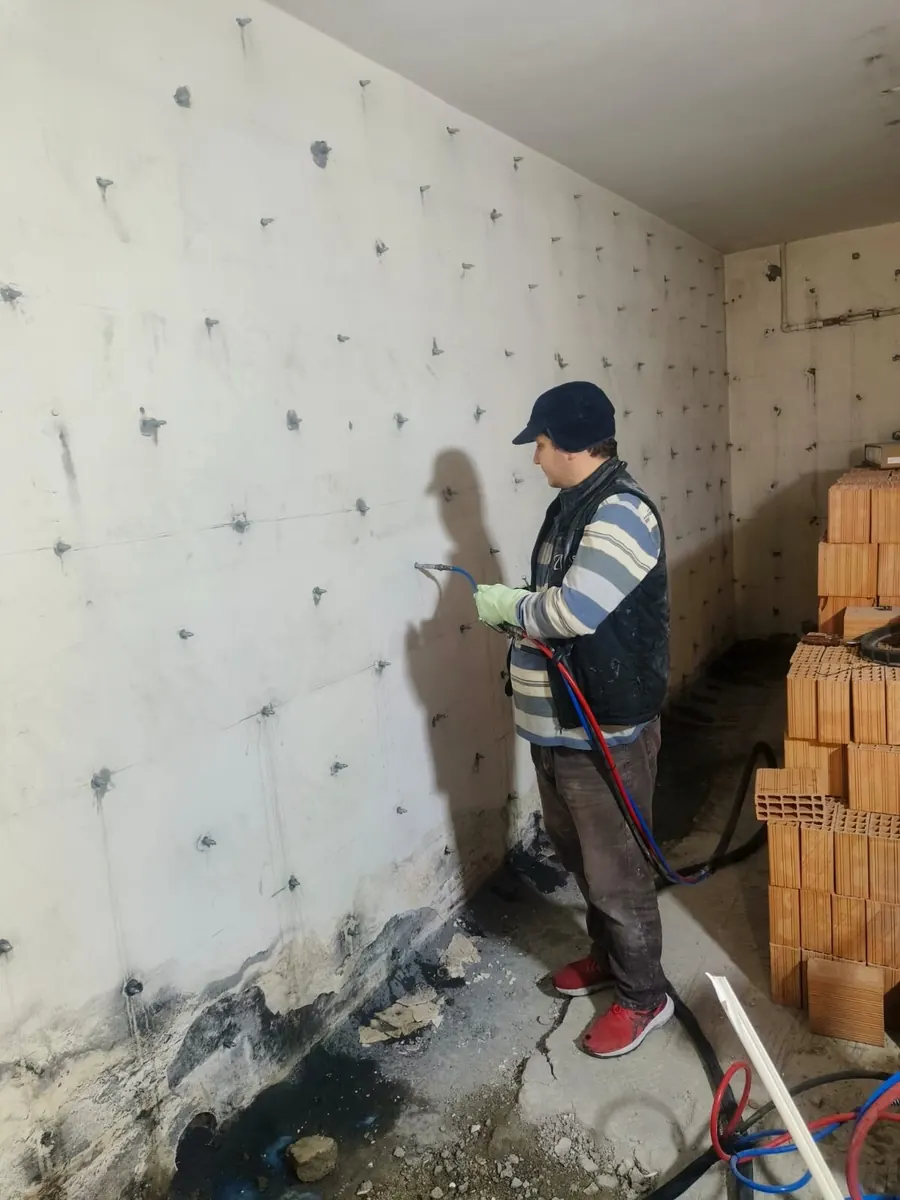
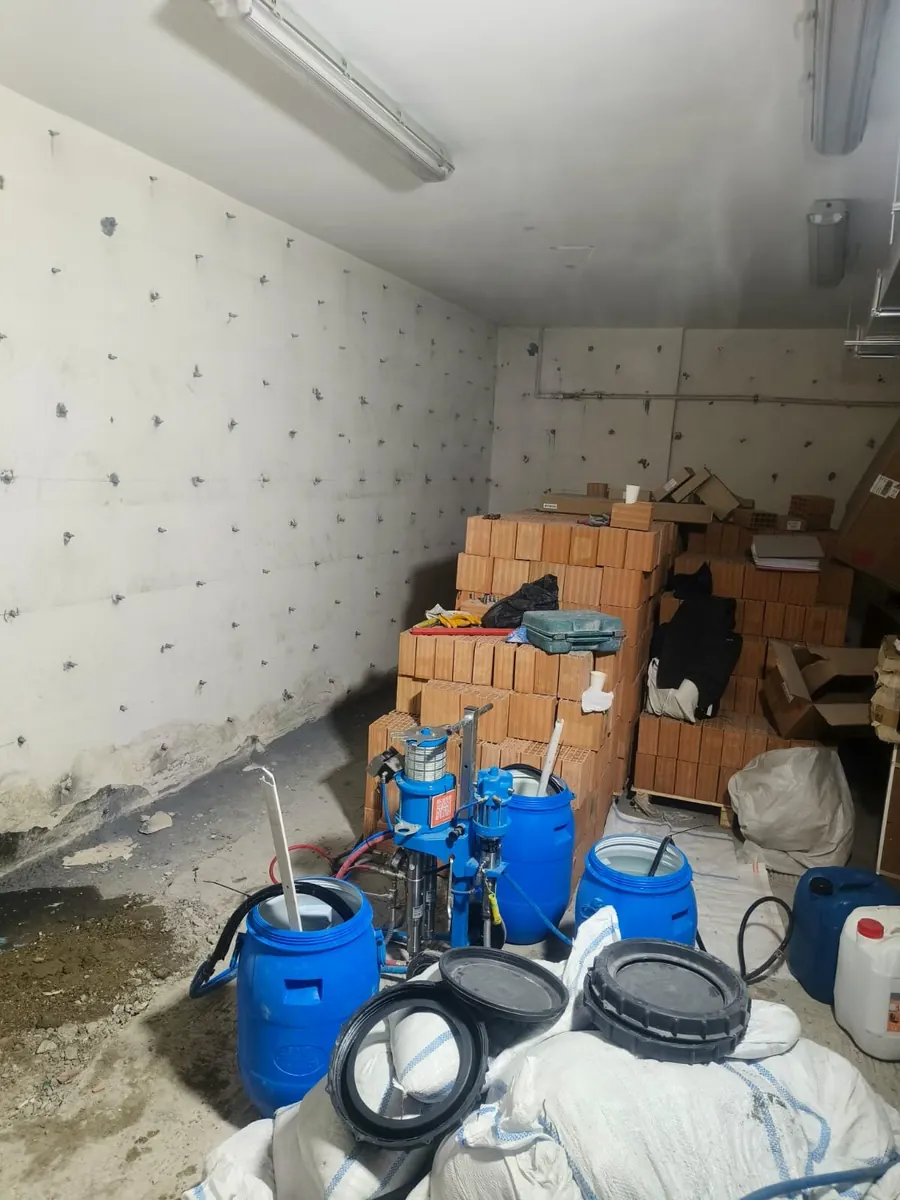
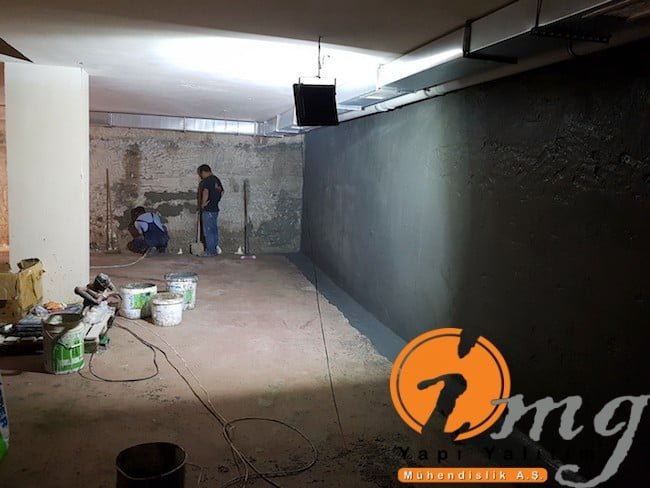
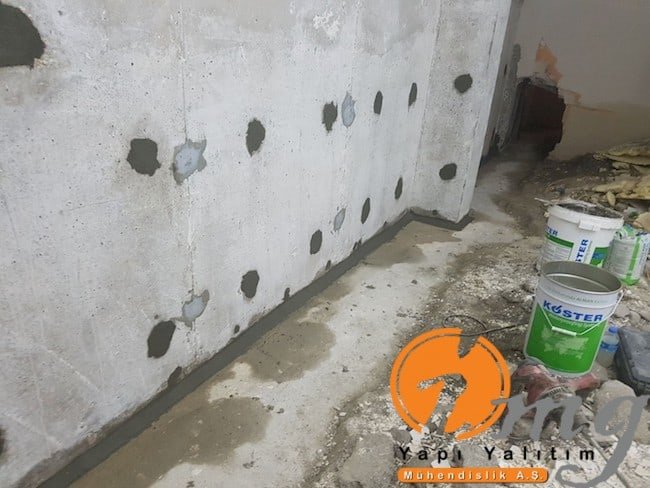
Two shots from a job in the basement wall of a commercial building. You can see the packers in a grid along the wall and the two-component injection pump. These photos are not illustrative; they come from our own site.
Curtain injection does not repair the existing external waterproofing; it puts a gel layer in its place. In some areas re-injection may be needed over time, and we tell you this at the start.
The gel cures with water. In ground that stays dry for a long time in summer it can shrink, and it can recover when it gets wet again. We monitor these zones.
Nobody can know in advance exactly what the void and ground behind the wall are like. That is why we start with a trial area and record the quantity in the site record.
If there is a structural crack, reinforcement corrosion or settlement, a structural assessment comes first.
Acrylate gel is not a single method; how it is applied depends on where the water comes from. The highlighted row is the subject of this page.
| What you see | The right application |
|---|---|
| A large part of a buried RC basement wall is wet; water comes through cracks and cold joints | Curtain injection behind the wall (D-06) (this page) |
| Water comes in through the joint between two blocks; the old sealant or tape has failed | Expansion joint gel injection (D-07) |
| Water and salts come through the body of a rubble stone or masonry wall; the outside face cannot be reached | Stone wall body injection (D-08) |
| Water rises from under the slab, through cracks and joints in the floor concrete | Under-slab and foundation gel injection |
| The lower part of a brick or stone wall is damp, there is no water pressure, paint and plaster blister from the bottom | Not gel: D101 DampStop rising damp injection |
| A single crack or service penetration leaks at one spot | Crack injection (PU or acrylate gel) |

All the materials we use in curtain injection are products of our own brand, Dryvatec. Applicator companies can buy the same products directly from Dryvatec.
Because we make the material ourselves, whatever we run into on site goes straight back into the formula and the application instructions. The section drawing and steps on this page are part of the Dryvatec application detail set.
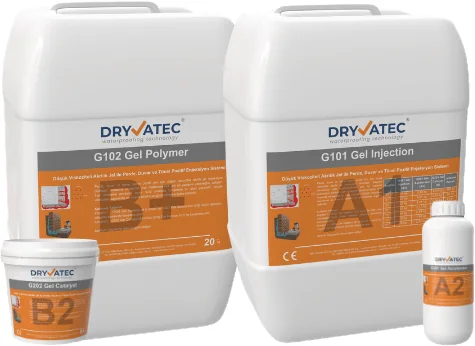
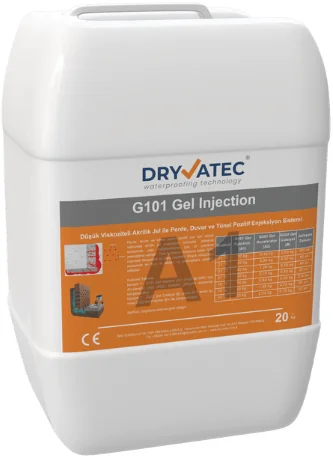
The core material of the system. A four-component acrylate gel almost as thin as water (5–30 mPa·s); it gets into hairline cracks down to 0.05 mm wide and stays flexible once cured.
Product page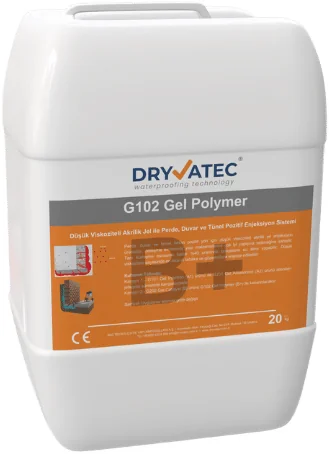
An acrylic polymer that makes the gel more flexible and improves its bond to concrete. In moving cracks and joints it replaces some or all of the water in the mix.
Product page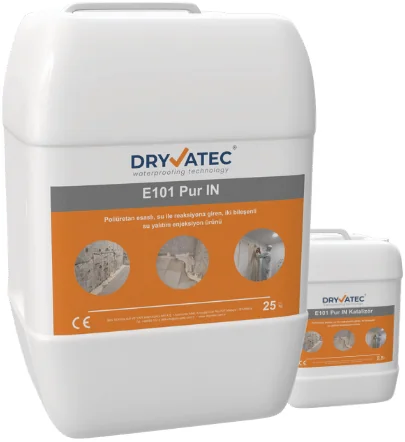
Polyurethane injection that stops water flowing under pressure. If there is an active leak it goes in before the gel; pumping gel while water is still running just washes the material away.
Product page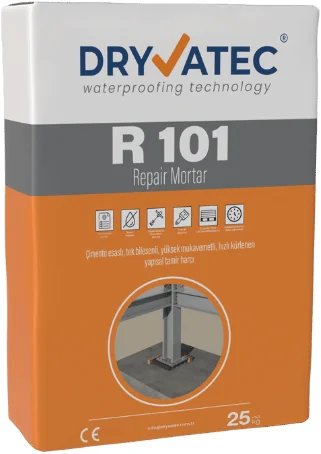
Repair mortar that closes the holes after the packers come out, as well as opened joints and broken surfaces.
Product page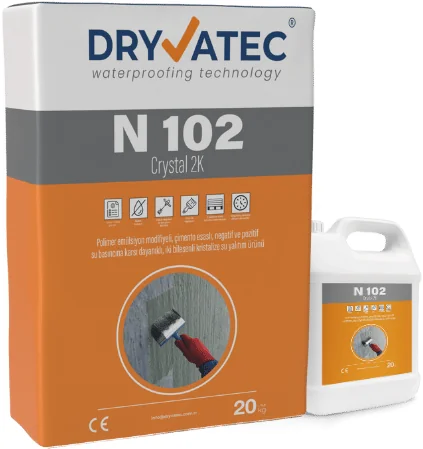
A two-component crystalline waterproofing applied to the inside face. Optional after injection, as a second line of protection and a clean finished surface.
Product pageOur YouTube channel has real site footage of our injection work.
We carry out curtain injection with teams based in Istanbul and Izmir. We have also worked in Ankara, Eastern Anatolia and Thrace, and depending on the size of the project we work across Turkey.
From our Maltepe office to every district on the European and Asian sides.
From our Konak office to every district of Izmir and the wider Aegean.
The moving joint between two blocks sealed from inside with flexible gel, both within the joint and behind it.
Application detailIn rubble stone and masonry walls, a water-stopping layer formed inside the wall with gel through the mortar joints.
Application detailWhen the water comes up from under the basement slab: a gel layer beneath the slab, without breaking it out.
Application detailSend us a few photos of the wall and the length of the wet area through the survey request form, or give us a call. Let us see together at the survey whether curtain injection suits your building.