
Water ingress in basements is one of the most common structural problems affecting buildings in Turkey. According to a study carried out by the Istanbul Metropolitan Municipality on 55,000 homes, 79% of structural damage stems from inadequate or faulty waterproofing. If you can see damp patches, salt deposits or active water ingress in your basement, this guide is for you.
Why Do Basements Let Water In?
Water ingress never has just one cause. Water from different sources penetrates the structure by different paths and is stopped by different methods. Without an accurate diagnosis, any intervention is no more than a temporary fix.
1. Hydrostatic Pressure (Groundwater)
Groundwater rising during wet periods exerts hydrostatic pressure on the below-ground structure. This pressure forces water inwards through micro-cracks and permeable weak points in concrete and wall surfaces. In Istanbul's coastal districts and areas close to the sea in particular, this pressure can be extremely high.
2. Capillary Action
Concrete and masonry walls are porous materials by nature. Like a sponge, these pores draw ground moisture upwards and keep the concrete surface permanently damp. This phenomenon is known as capillary action, or capillary suction. Even where there are no fine cracks, water can work its way into concrete through capillary suction alone.
3. Structural Cracks and Expansion Joints
Settlement, thermal movement and seismic loads lead over time to cracks forming within the concrete. Column-beam junctions, slab-to-wall connections and, above all, expansion joints are the points most at risk of water ingress. Purpose-designed detail solutions must be applied at these points to prevent the passage of water.
4. Inadequate or Faulty Original Waterproofing
The waterproofing installed when the building was constructed may have been wrongly specified, incompletely applied, or may simply have deteriorated over time. In buildings more than 20 years old in particular, tearing, slippage and loss of adhesion in bituminous membranes are very common.
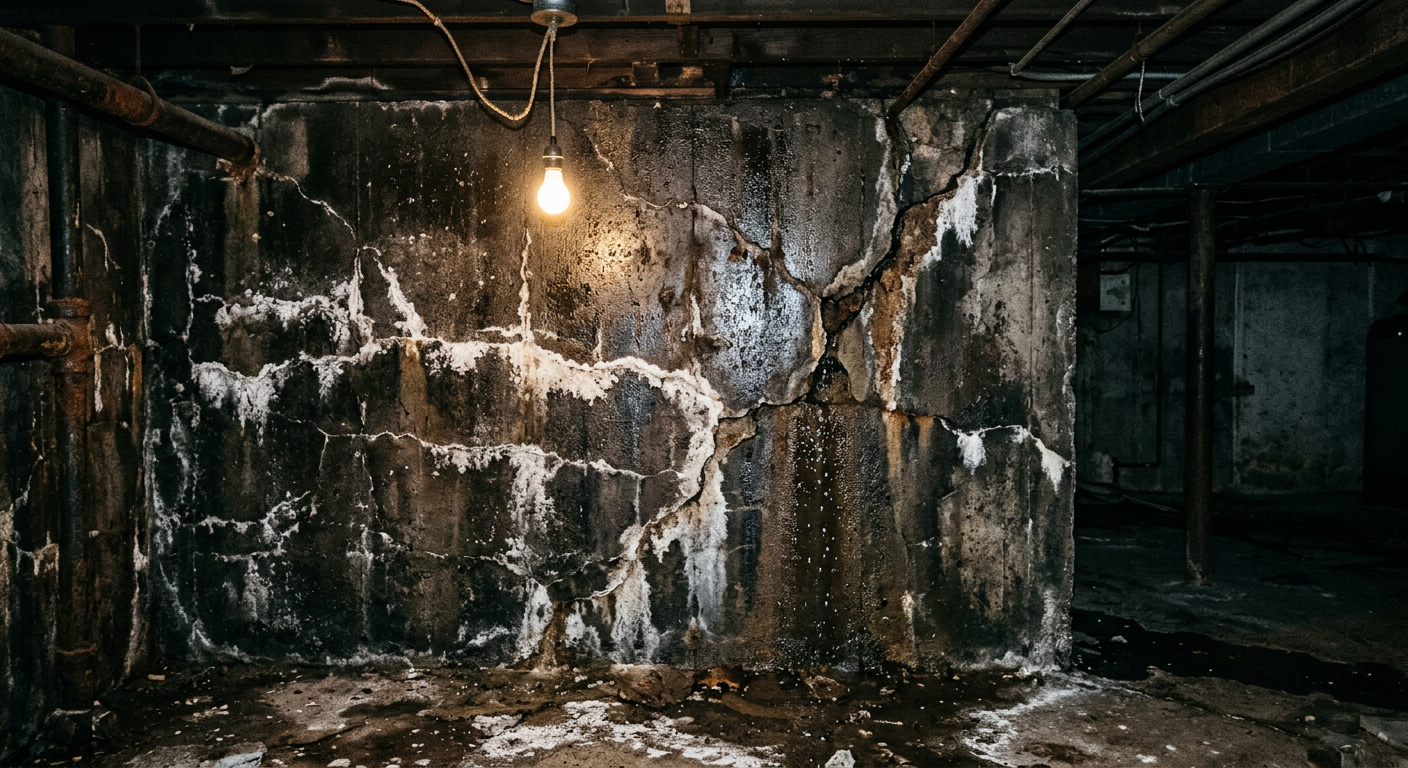
Efflorescence (salt deposits), active water ingress and cracked concrete — the classic damage picture seen in basements.
The Signs of Water Damage in a Basement
A water problem in a basement does not always announce itself with an active flow of water. If you observe one or more of the signs below, we recommend contacting a specialist:
- Efflorescence (salt deposits): White-grey crystalline deposits forming on concrete or plaster surfaces. This is a sign that water is dissolving minerals within the concrete and carrying them to the surface.
- Damp patches and blistering paint: Discolouration of the wall surface and blistering paint or plaster point to the long-term presence of moisture.
- Mould and a musty smell: On top of poor ventilation, damp walls create the ideal environment for mould spores to multiply.
- Active water flow or a wet floor: Indicates the presence of significant hydrostatic pressure; it requires urgent intervention.
- Surface flaking and spalling: Mechanical deterioration sets in on the surface of concrete exposed to prolonged damp.
Basement Waterproofing Methods
Different methods are applied depending on the nature of the problem, the geometry of the structure and whether excavation is possible. Without a professional diagnosis, there is no such thing as "the best method".
Negative-Side Waterproofing (Internal Application)
This is the method of choice for buildings on adjoining plots where excavation is impossible, or where the cost of excavation would be prohibitive. Crystalline waterproofing materials are applied to the concrete surface, penetrate the capillary pores of the concrete and form nano-scale crystals within it. These crystals grow over time to form an impermeable barrier against water. In BS 8102 terms, this is Type A (barrier) protection applied from the inside — what the UK industry calls internal cementitious tanking.
The advantage of negative-side waterproofing is its resistance to hydrostatic pressure. Its disadvantage is that it works on the principle of blocking water only after it has entered the structure — long-term performance therefore depends on choosing the right material. For more information, visit our basement negative-side waterproofing service page.
Positive-Side Waterproofing (External Application)
Placing the waterproofing layer between the water and the structure is, in theory, the soundest approach. In this method, the perimeter of the building is excavated to expose the external face of the concrete, which is then cleaned and repaired. A bituminous membrane, bentonite sheeting or an elastomeric coating is then applied. On new builds, this is the standard practice.
For existing buildings, external waterproofing is generally not an option, as dense urban fabric leaves no room for excavation. Where excavation is feasible, however, this method is the most permanent solution in the long term.
Waterproofing by Injection
At points of active water ingress and along cracks, polyurethane or acrylate gel injection is used. Injected under pressure through holes drilled into the structure, the material expands on contact with water, filling the void and stopping the leak. It performs both a filling and a waterproofing function.
For detailed information on injection methods, see our injection waterproofing page.
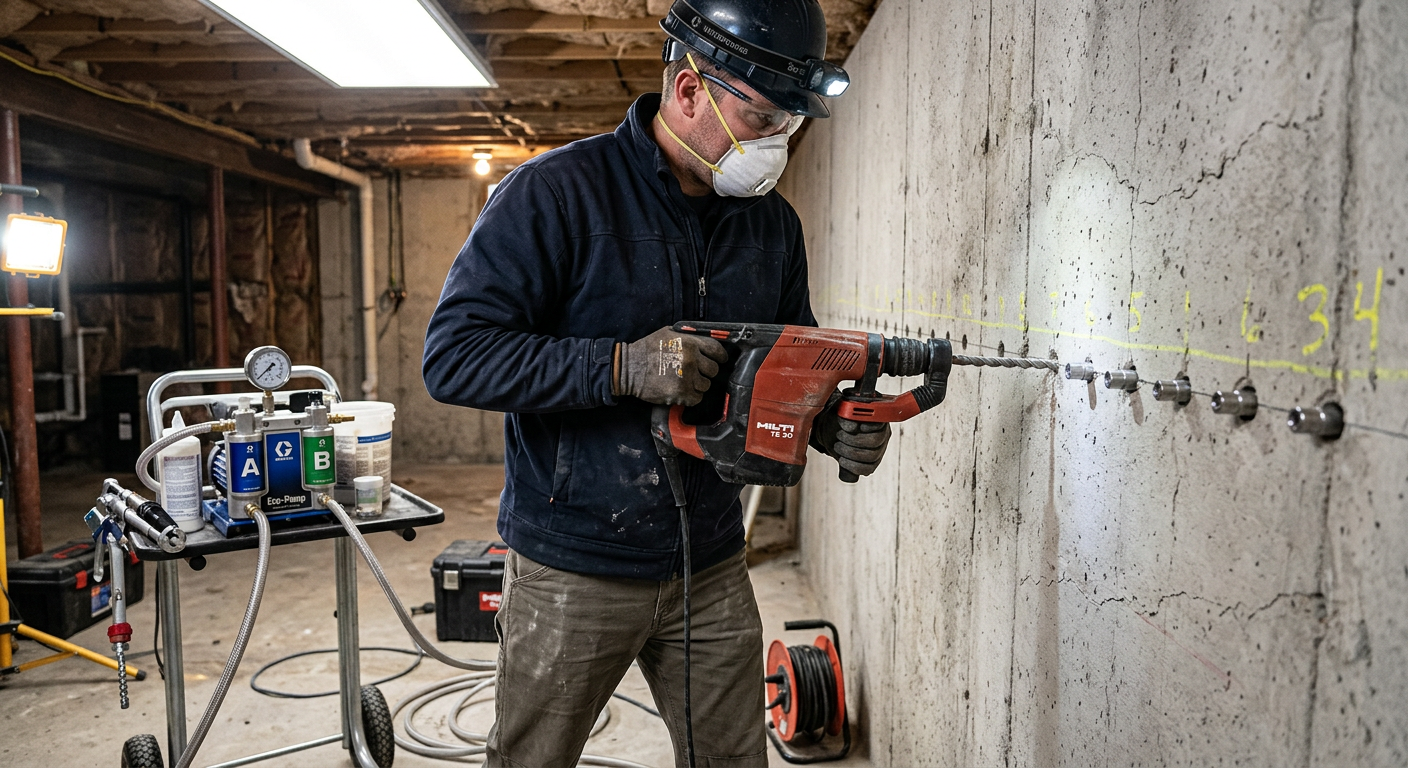 The injection method: polyurethane foam or acrylate gel is pumped under pressure through holes drilled into the concrete surface.
Surface Preparation Before Application: The Most Critical Step
The most common cause of failure in waterproofing is inadequate surface preparation. It does not matter how good the material is; any coating applied to a loose, dirty or damp surface will come away in short order.
Proper surface preparation covers the following:
- Mechanical removal of loose concrete, plaster and surface contamination
- Filling cracks and voids with repair mortar
- Forming cove fillets at column-beam corners (to reduce stress concentration)
- Measuring the moisture content of the substrate
- Stopping any active water ingress first, where necessary
Applying Crystalline Waterproofing to Concrete
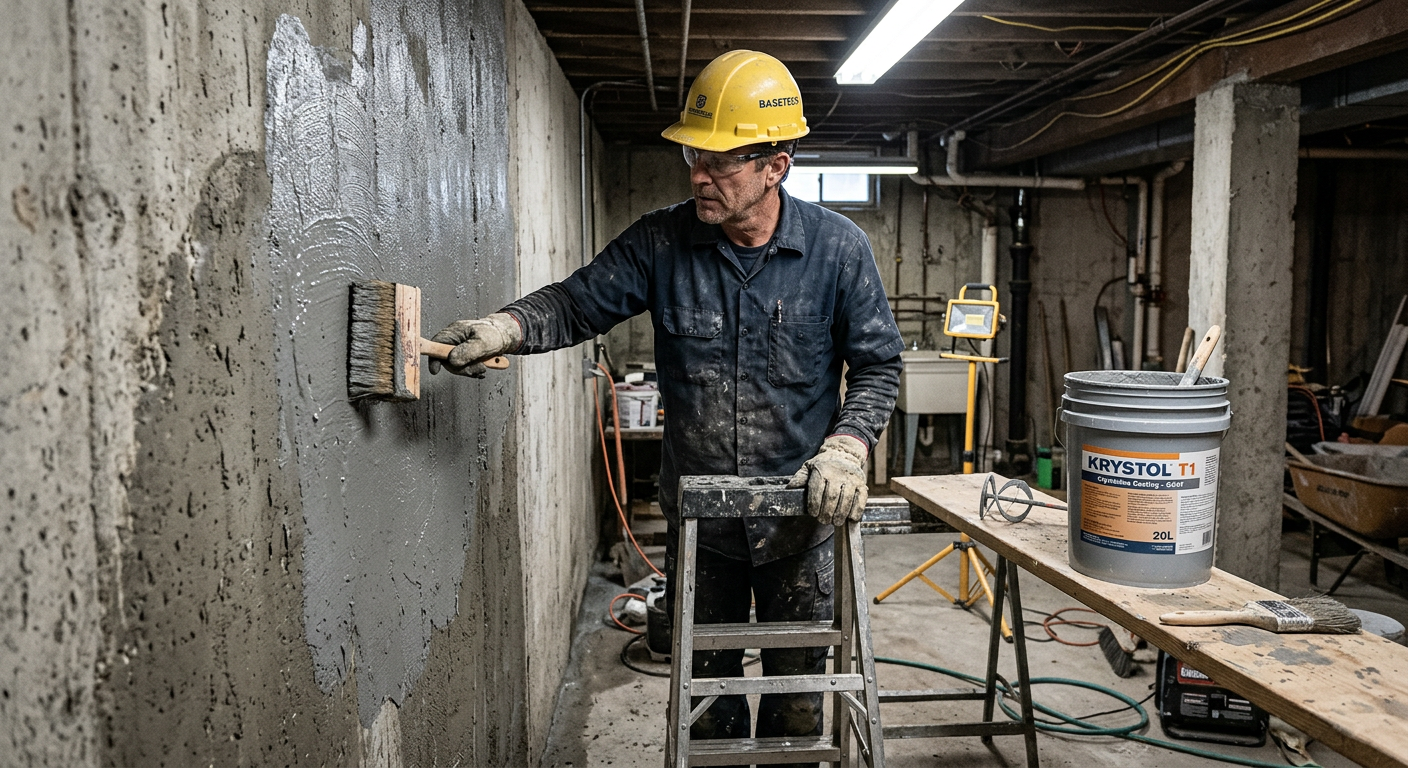 Crystalline waterproofing material is applied to the wet concrete surface by brush or roller. The concrete must be wet for the reaction to take place.
Crystalline waterproofing materials work on the principle of a chemical reaction. Composed of cement, quartz sand and active chemical compounds, these products form insoluble crystalline structures within the capillary channels of the concrete on contact with water. This structure:
- can self-heal micro-cracks of up to 0.4 mm (autogenous healing)
- withstands both negative-side (inside-out) and positive-side (outside-in) water pressure
- is resistant to freeze-thaw cycles
- remains active for the entire life of the concrete
Basement Waterproofing Videos
You can watch real project applications by our İMG Mühendislik team in the videos below:
Common Mistakes in Basement Waterproofing
Below we have compiled the most common mistakes we have seen over the years:
- Assuming it is enough to apply the material to the surface: A coating applied to an uncleaned surface with unfilled cracks will not bond.
- Treating only the "visible" areas: The point where the water shows itself and its actual source are, more often than not, two different places.
- Choosing the wrong material: Using materials designed for positive-side waterproofing in negative-pressure conditions simply does not work.
- Applying to a dry surface: The surface must be wet for crystalline materials to react.
- Neglecting corners and junctions: It is the transitions and corners, not the flat surfaces, that are the points most at risk.
- Cutting down the number of coats: Reducing the number of coats to save money renders the whole job worthless in the long run.
When Should You Call In a Professional?
The great majority of basement water problems cannot be solved by homeowners with their own means. You should seek professional help when:
- There is active water flow or a wet floor
- Salt deposits keep coming back (a chronic problem)
- A previous intervention has failed
- Cracks are growing year on year
- The basement is in use as a home or office
Fill in the building information form and our technical team will provide a preliminary assessment. In Istanbul and Izmir we guarantee a response within 24 hours.
Basement Waterproofing in Istanbul and Izmir
As İMG Yapı Yalıtım Mühendislik A.Ş., we provide basement waterproofing across Istanbul (Maltepe, Kadıköy, Üsküdar, Beşiktaş, Şişli, Beylikdüzü and all districts) and Izmir (Konak, Bornova, Karşıyaka, Bayraklı and all districts).
All our basement applications carried out with Dryvatec-branded crystalline and injection products come with a 5-year written warranty. For detailed information about our services, visit our basement waterproofing page or call us: 0850 532 6 999