
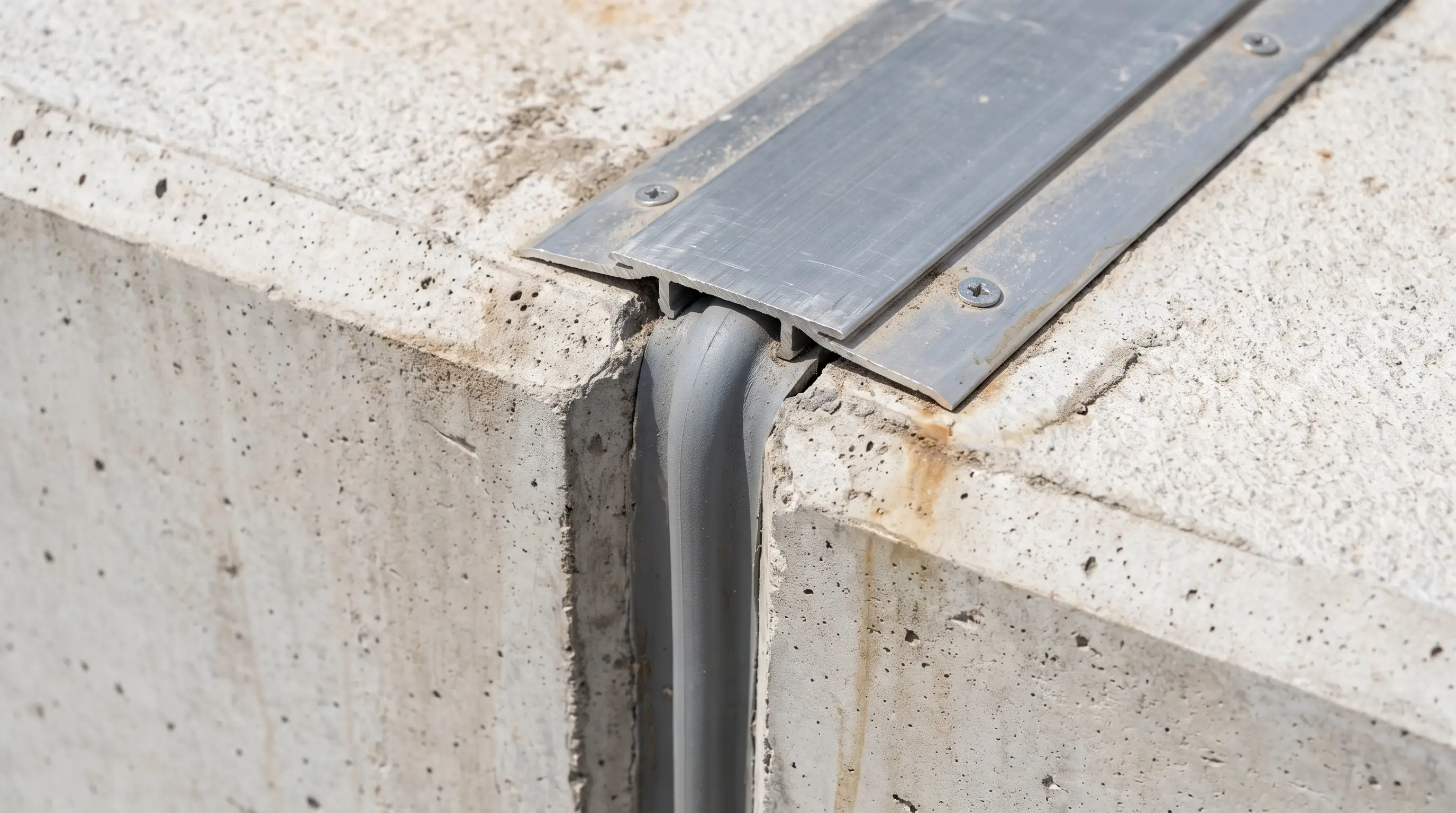
You will have noticed those line-like gaps set at regular intervals into the ceilings, walls or floors of buildings. They are not random; they are expansion joints — details that are essential to the health of the structure. From a waterproofing point of view, however, they are also among its most sensitive points: an expansion joint that has not been resolved correctly is one of the most common sources of water leaks. In this article we explain what expansion is, why the joint is needed and how it is made watertight.
What Is Expansion?
Expansion — and its counterpart, contraction — is the dimensional change of building materials under effects such as temperature swings, moisture, earthquakes and ground settlement. Concrete and reinforcement expand in heat and contract in cold. If these movements are restrained, uncontrolled cracks form in the structure. An expansion joint concentrates this inevitable movement in a planned gap, protecting the rest of the structure from cracking.
Why Are Expansion Joints Needed?
An expansion joint has three core functions:
- Accommodating expansion and contraction: it gives temperature-driven dimensional change the freedom to move.
- Earthquake safety: it allows large structures, or structures made up of differing blocks, to move independently of one another during an earthquake.
- Separating differential settlement: where the ground settles unevenly beneath different areas, it confines the damage to the joint.
In short, an expansion joint is the safety gap that lets the structure "breathe". Without it, a roof heating up in the sun or a building swaying in an earthquake would crack itself apart.
Why Are Expansion Joints Critical for Waterproofing?
By definition, a joint is a gap that never stops moving. An ordinary membrane or rigid coating cannot cope with this movement; it soon tears, and the joint starts letting in water. On terraces, in car parks, in water tanks and on retaining walls, the great majority of water leaks come precisely from the expansion joints. Joint waterproofing therefore calls for a special movement-accommodating detail, quite different from standard surface waterproofing.
A correct expansion joint detail: an elastic seal/waterstop that absorbs the movement + a protective profile. The joint keeps moving — the watertightness holds.
How Is an Expansion Joint Waterproofed?
The aim in movement-joint waterproofing is to maintain watertightness even as the joint opens and closes. The main methods:
- Waterstops: PVC- or bentonite-based strips embedded in the joint as the concrete is poured.
- Elastic joint seals and sealants: polyurethane-based fillers with high elongation capacity.
- Looped (bellows-type) membranes / joint profiles: special tapes with a central loop, and metal profiles, that concentrate the movement within themselves.
- Injection: in existing, leaking joints, stopping the water by delivering elastic resin using the injection method.
The right solution is chosen according to the joint's location, width, amount of movement and the water pressure. We cover this detail end to end on our expansion joint (movement joint) waterproofing service page.
Frequently Asked Questions
Is an expansion joint the same as an ordinary joint?
No. A contraction (control) joint manages cracking as the concrete cures; an expansion joint, by contrast, cuts through the entire structure and is a permanent joint that allows far greater movement. The waterproofing solutions differ too.
What should be done if an expansion joint is leaking?
First, the amount of movement and the source of the water are established. Any active flow is stopped by injection, and the detail is then rebuilt with an elastic seal or profile that permanently accommodates the movement. Filling the joint with a rigid material brings the problem back in short order.
Can an expansion joint be closed up?
The joint itself is structurally necessary; it cannot be eliminated. The task is not to close the joint, but to make it watertight while still allowing it to move.
Expansion Joint Waterproofing in Istanbul and Izmir
As İMG Yapı Yalıtım Mühendislik A.Ş., we apply permanent, movement-accommodating solutions to expansion joints in terraces, car parks, water tanks and retaining walls across Istanbul and Izmir — with the products of our own brand, Dryvatec, and a 5-year written warranty. For a site survey and further information, fill in the building information form or call: 0850 532 6 999
Related services: Expansion Joint Waterproofing · Injection Waterproofing · Flat Roof & Terrace Waterproofing