
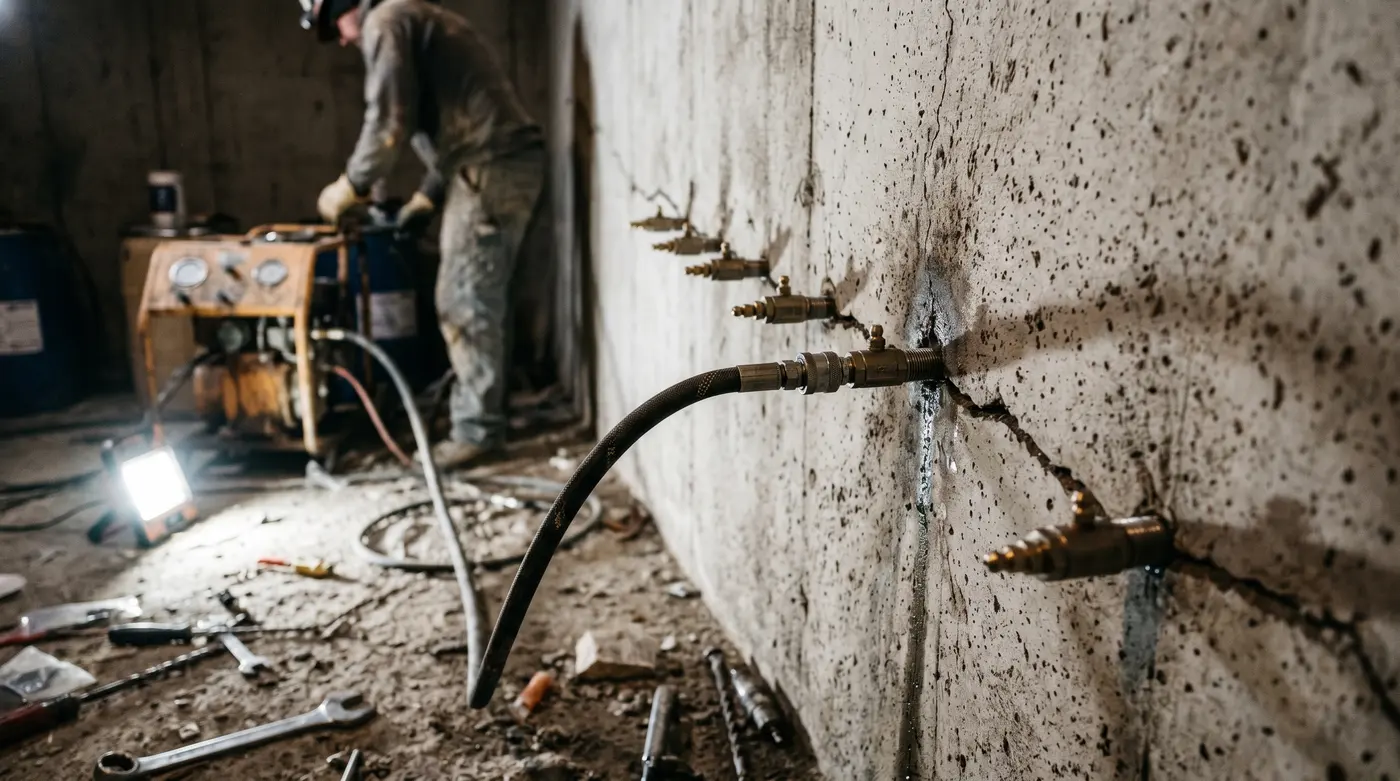
Injection is the fastest and least invasive way to stop an active water leak: material pumped under pressure through holes drilled into the concrete fills the voids the water travels through, from the inside. But "injection" is not one single thing — polyurethane resin and acrylic gel, the two materials most widely used on site, work on different principles and are right for different problems. Choosing the wrong material means a leak that returns within a few months.
How Does Injection Work?
Holes are drilled at a 45-degree angle along the crack or joint line, and mechanical injection ports known as packers are fitted into them. A high-pressure pump drives the material in through the packer; it travels into the finest capillaries of the crack and reacts there. The success of the application depends on the combination of the right drilling pattern, the right pressure and the right material.
Polyurethane Injection: The Rapid-Response Specialist
On contact with water, polyurethane resin foams and expands to as much as 20-40 times its volume, hardening within seconds to minutes. This property makes it the "emergency service" of active water leaks.
- Where it is strongest: Actively running water, pressurised point leaks, concrete cracks, cold joints, tunnel and retaining-wall junctions.
- Advantages: Very fast reaction; can be applied even while water is flowing; withstands high pressure.
- Limitations: The cured foam is rigid; in moving (live) joints it may not last on its own. In a dry crack, water is needed for the foaming reaction.
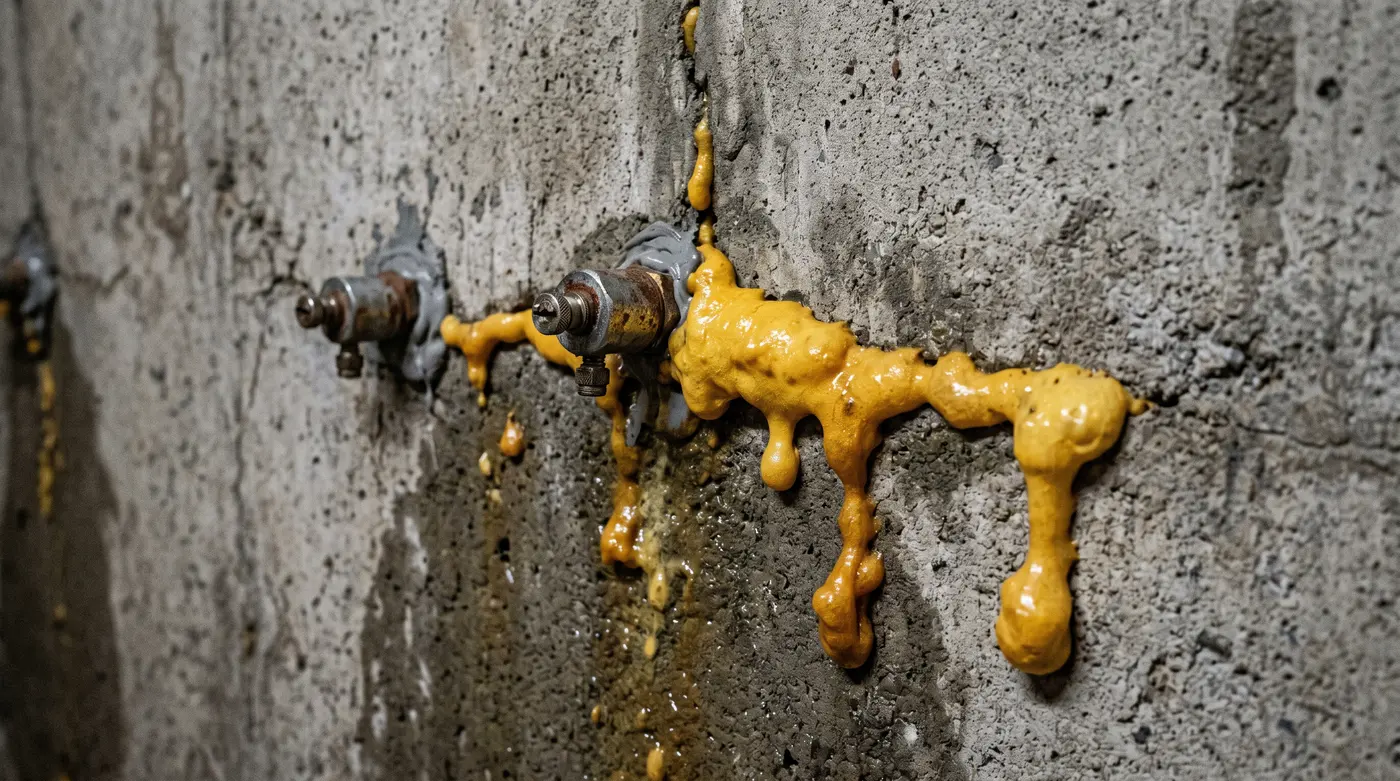 Reacting with water, polyurethane expands until it emerges from the crack — foam showing at the surface is the sign that the material has filled the crack completely.
Acrylic Gel Injection: The Permanent-Barrier Specialist
Acrylic gel is a material of almost water-like consistency (very low viscosity); it seeps into capillary voids that even polyurethane cannot enter. Its reaction time is adjustable; once gelled, it forms a flexible, rubber-like mass that swells in water-saturated conditions, further enhancing its sealing effect.
- Where it is strongest: Curtain injection behind the wall (on the soil side), forming a barrier at the structure-ground interface, moving cracks, widespread damp penetration.
- Advantages: Permanent flexibility; tolerates structural movement; bonds with the soil behind the wall to create an external waterproofing effect — establishing a positive-side barrier without excavation.
- Limitations: Not as fast as polyurethane at instantly cutting off a strong, active flow of water; the application demands more expertise and specialised pumps.
As one of the first companies in Turkey to apply acrylic gel injection from the negative side, we describe this method in detail on our acrylic gel injection service page.
Which One When? A Practical Selection Guide
- Water is gushing or running from the wall: Polyurethane. Stop the water first, then build the permanent system.
- There is a crack and the leak is intermittent: Acrylic gel, or a polyurethane-plus-gel combination — the decision depends on whether the crack is live.
- The wall is generally damp with no distinct crack: A barrier behind the wall by acrylic gel curtain injection, plus a crystalline coating on the surface.
- Expansion / movement joints: Systems that remain flexible; rigid foam is never used on its own. See our expansion joint waterproofing page for details.
- Lift pit base: Usually a combination of the two materials plus a crystalline coating. Lift pit waterproofing is a specialism in its own right.
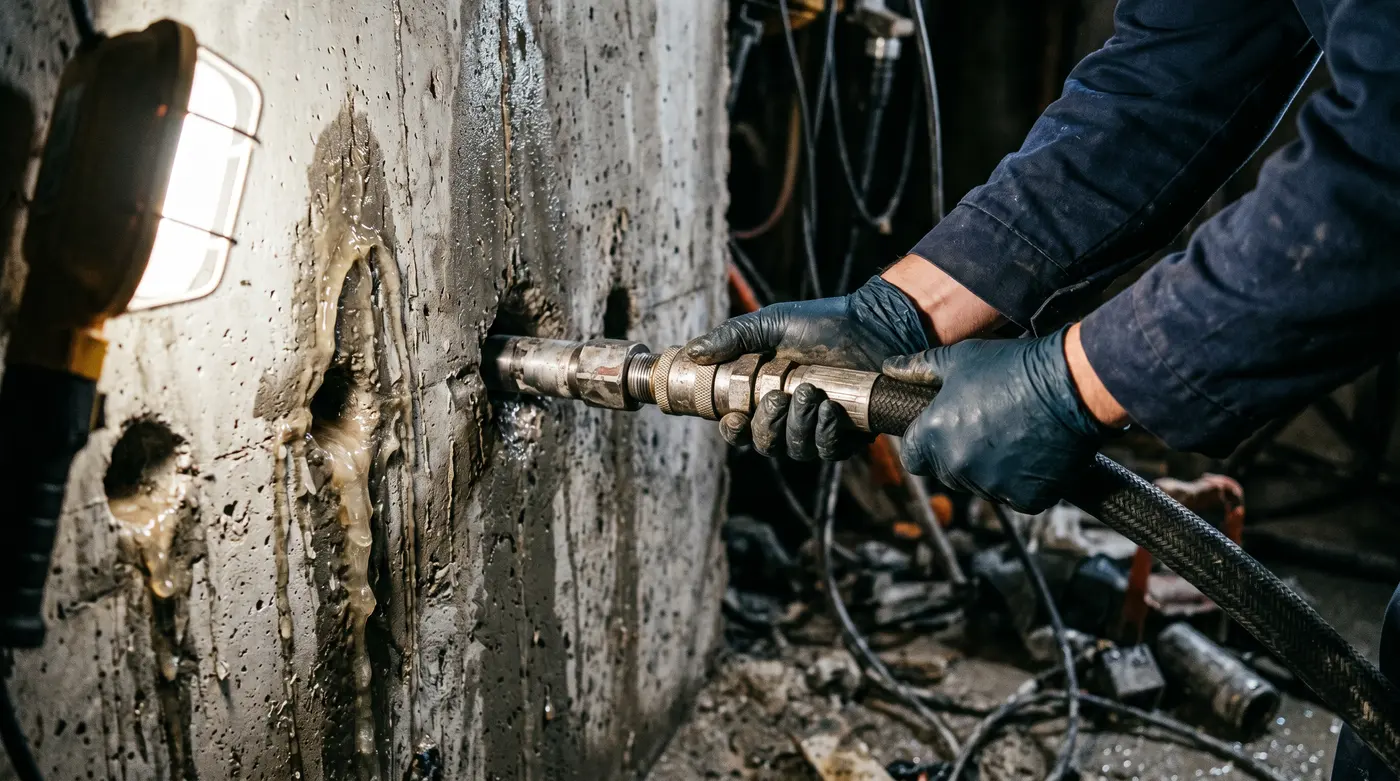 With its water-like consistency, acrylic gel travels into capillary voids that polyurethane cannot reach.
The Two Methods Together: The System We Build Most Often on Site
On real projects we frequently use the two materials in sequence: first, polyurethane stops the active flow within seconds; the same line is then re-injected with acrylic gel, filling the capillary voids and forming a flexible, permanent barrier. With a Dryvatec crystalline coating applied on top, the system becomes three-layered: emergency intervention + permanent barrier + crystalline waterproofing within the body of the concrete.
Frequently Asked Questions
Does injection damage the building?
No. The holes are small in diameter and do not harm the load-bearing structure; after the application the packers are removed and the holes are sealed with repair mortar. The pressure is adjusted to the condition of the concrete by an experienced applicator.
How many years does injection last?
With the right material and correct application it is permanent; acrylic gels and polyurethane resins maintain their performance for the life of the structure. We back all our injection work with a 5-year written warranty.
How many days does it take?
Point leaks are usually dealt with the same day; more extensive work such as curtain injection takes 1-3 days depending on the size of the area.
Injection Waterproofing in Istanbul and Izmir
Across Istanbul and Izmir we carry out polyurethane and acrylic gel injection using Dryvatec products, backed by a 5-year written warranty. In the event of an urgent water leak, reach us on 0850 532 6 999 or fill in the building information form.