
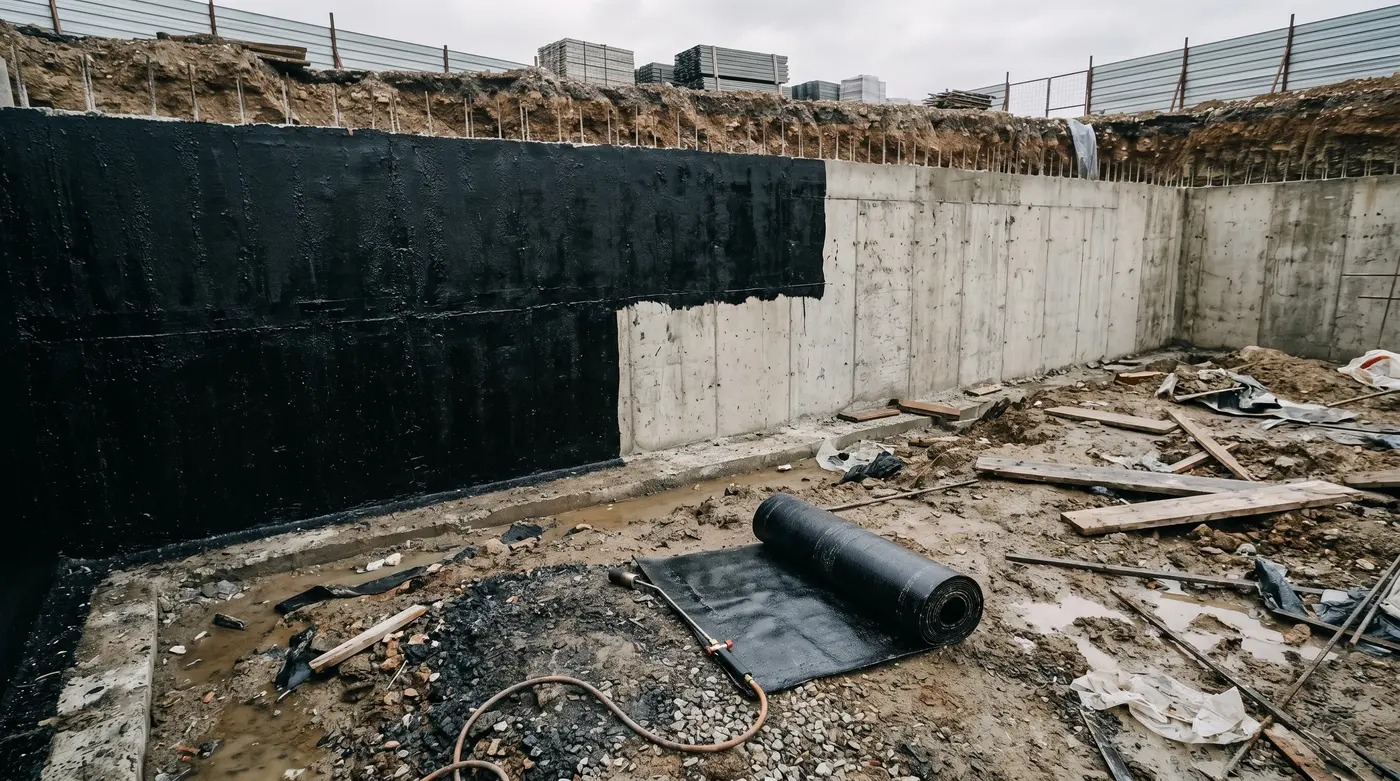
When comparing waterproofing quotes you will come across two fundamental concepts: positive-side waterproofing and negative-side waterproofing. These terms describe not the material, but which side the application is made on, relative to the water. The right choice depends on the age of your building, its location and whether excavation is possible — and that choice determines both the cost and the durability.
Positive-Side Waterproofing: On the Side the Water Comes From
Positive-side waterproofing means applying the waterproofing layer to whichever surface the water comes from. For a basement retaining wall, this means excavating around the building and applying a bituminous membrane, a liquid-applied coating or bentonite to the external face. The water is stopped before it ever reaches the concrete.
- Advantages: The concrete is never exposed to water; the risk of rebar corrosion is minimised. It is the standard — and mandatory — approach on new builds.
- Disadvantages: On an existing building it requires excavation — in the tightly packed, adjoining-building fabric of Istanbul and Izmir this is often physically impossible. Even where excavation is possible, the cost of machinery, drainage, backfill and landscape reinstatement is high.
Negative-Side Waterproofing: On the Side the Water Emerges
Negative-side waterproofing is applied on the side opposite the water — that is, from inside the building. The critical point here is this: an ordinary paint or brush-applied coating will blister and detach under the water pressure coming from behind. For negative-side waterproofing to work, you need materials that act within the body of the concrete.
The backbone of modern negative-side waterproofing is crystalline technology: active chemicals applied to the concrete surface react with moisture and grow insoluble crystals inside the capillary voids of the concrete. The waterproofing layer forms not on the surface but within the concrete itself — which is why pressure from behind cannot "push it off". For the details of the crystalline system, see our article on crystalline concrete admixtures.
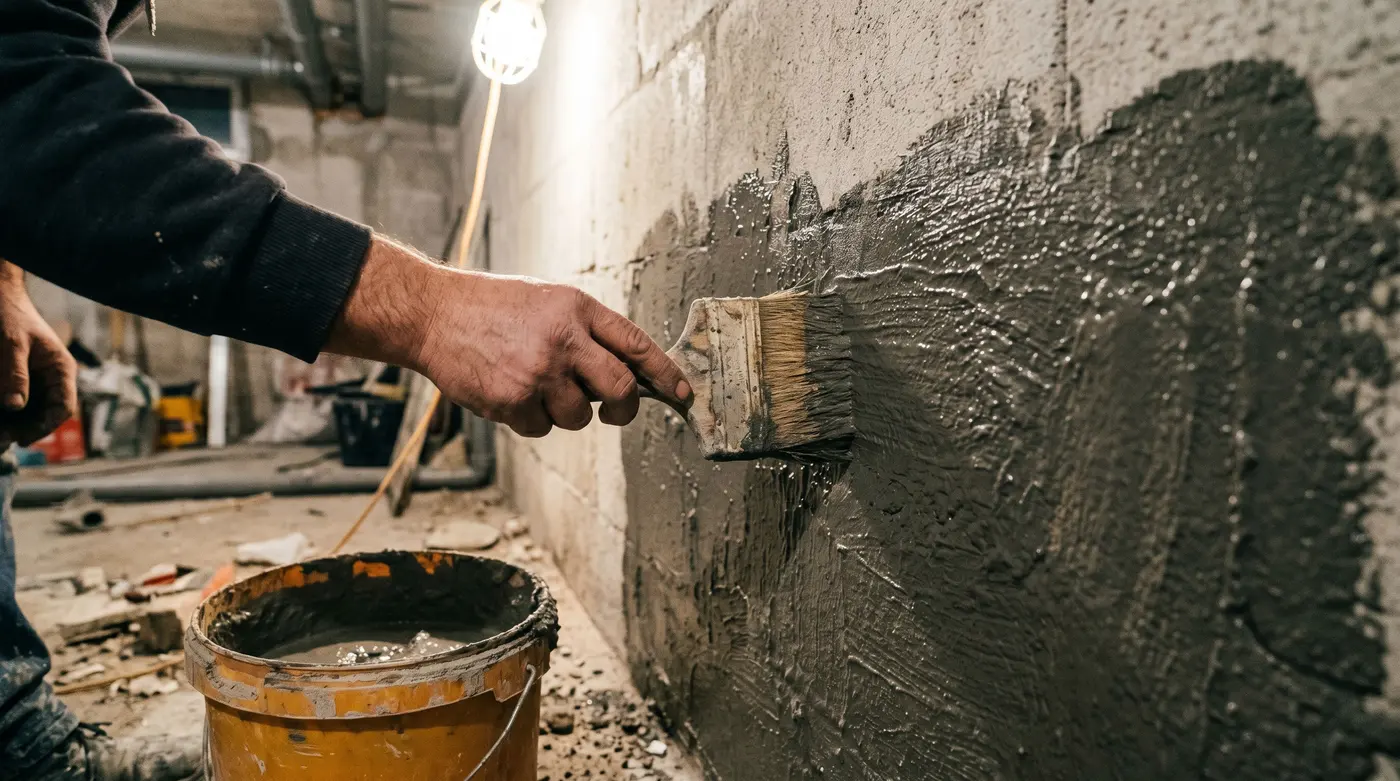 In negative-side waterproofing the crystalline coating is applied from the inside; active chemicals weave a water-blocking crystal network within the body of the concrete.
The "Internal Waterproofing Never Holds" Myth
This claim, still heard in the industry, is the legacy of applications done with the wrong materials. If you apply a film-forming (paint-type) material to a surface under pressure from behind, it genuinely will not hold. But the crystalline system + injection combination works inside and behind the concrete:
- the crystalline coating creates watertightness within the body of the concrete,
- acrylic gel injection spreads behind the wall, on the soil side, and forms a barrier curtain there.
In other words, a properly engineered negative-side system actually establishes a positive-side barrier behind the wall as well — without excavation. This system has delivered permanent results in thousands of basements; it is the basis on which we give a 5-year written warranty on all our applications.
Which Is Right in Which Situation?
- New build: Always positive-side (external) waterproofing, plus a crystalline admixture in the concrete where possible. Together they are the strongest combination.
- Existing detached building with open surroundings: Positive-side if the cost of excavation is acceptable; otherwise a negative-side system.
- Terraced building with adjoining neighbours: In practice the only option is the negative-side system — you cannot excavate under the neighbouring building. We cover this scenario in detail on our Istanbul foundation and retaining-wall waterproofing page.
- Lift pits, water tanks, boiler rooms: There is no external access anyway; the negative-side system is the standard.
- Active leak: Whichever side is involved, it is first stopped by injection, and the permanent system is built afterwards.
Cost Comparison
On an existing building, positive-side waterproofing — with its excavation, drainage, membrane and backfill line items — is generally several times more expensive than the negative-side system. With no excavation or landscape reinstatement, the total cost of a negative-side system is predictable and the work is quick. You can find all the items that affect the price in our article on waterproofing cost factors.
Frequently Asked Questions
Does negative-side waterproofing stop the concrete breathing?
No. The crystalline system blocks liquid water while remaining permeable to water vapour; the concrete continues to "breathe". This is also an advantage for maintaining the indoor moisture balance.
Can negative-side waterproofing be applied in every basement?
On concrete or reinforced concrete surfaces, yes. On irregular structures such as rubble stone walls, the system is engineered together with sprayed concrete and additional layers; this is clarified during the site survey.
My building is waterproofed externally — do I also need internal waterproofing?
Not if the external membrane is intact. But if the membrane has reached the end of its life (20+ years) and excavating to renew it is not possible, an internal crystalline system is the most sensible renewal route.
Negative-Side Waterproofing in Istanbul and Izmir
As İMG Yapı Yalıtım Mühendislik A.Ş., we are one of Turkey's pioneering companies in no-dig negative-side waterproofing. Across Istanbul and Izmir we work with Dryvatec crystalline and injection products, backed by a 5-year written warranty. For a site survey and information: 0850 532 6 999