
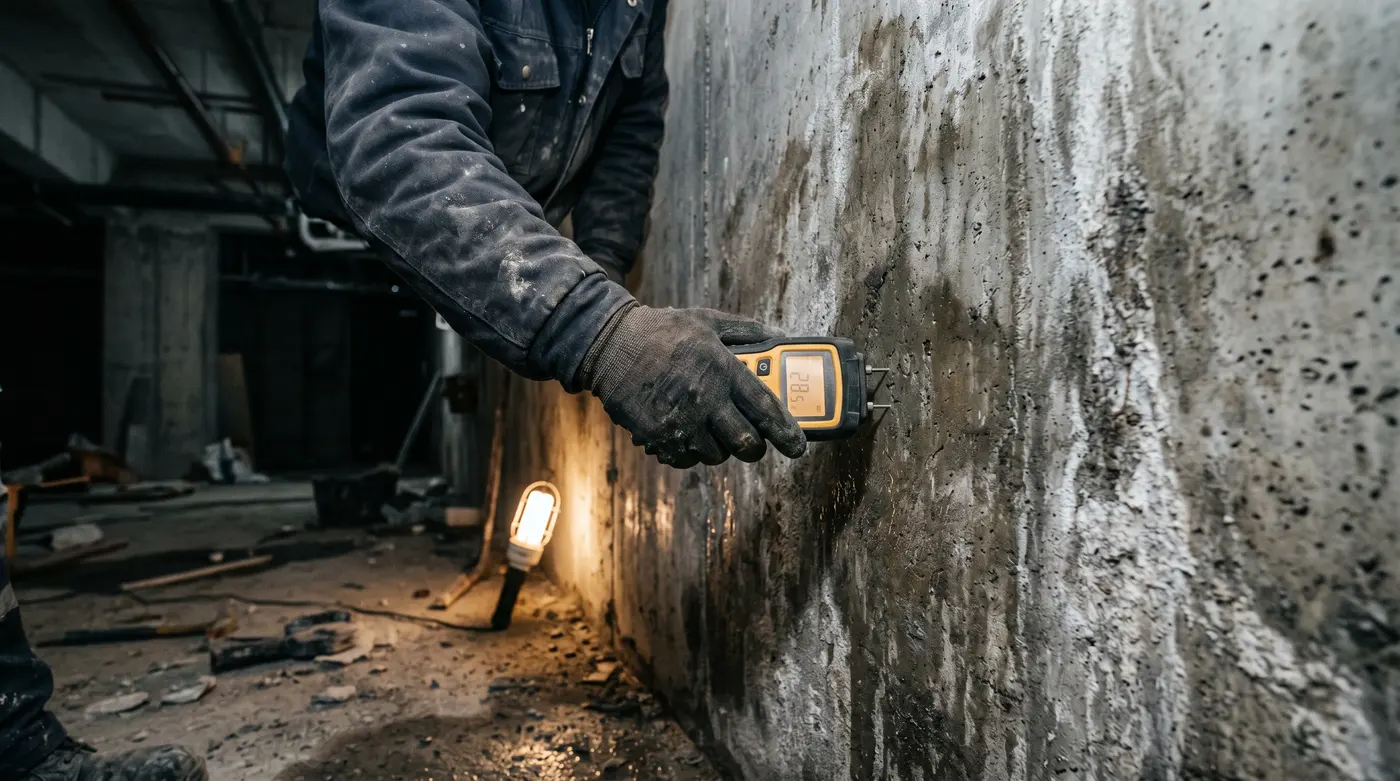
"How much does waterproofing cost per square metre?" — it's the question we hear most often in this industry. The honest answer: any price quoted without a site survey is only an estimate. Two basements of the same size can differ several-fold in waterproofing cost, depending on the source of the problem and the method chosen. In this article we go through the factors that determine the price one by one, and explain what to look out for when requesting a quote.
Why There Is No Fixed Per-Square-Metre Price
Unlike painting or tiling, waterproofing is a diagnosis-driven engineering task. You cannot choose a material or a method without knowing where the water is coming from, at what pressure, and by what path — and without a method, the cost cannot be calculated. A fixed per-square-metre price given over the phone will either change after the site survey or points to a one-size-fits-all application that won't actually solve the problem.
The 8 Factors That Determine the Price
1. The Source of the Problem and Diagnosis
Rising damp and groundwater pressure call for completely different solutions. An accurate diagnosis is reached through moisture measurement, thermal imaging where needed, and a review of the building's history. Every penny spent on a problem whose source has been misdiagnosed is wasted — we covered water-leak diagnosis methods in detail in this article.
2. The Method Applied
The method is the single biggest driver of cost:
- Crystalline coating (negative-side): Requires no excavation; material and labour costs are predictable.
- PU resin / acrylate gel injection: Priced per point; it varies with crack length and the number of injection packers.
- External membrane (positive-side): Usually the most expensive scenario, since excavation, machinery, drainage and backfill are all added to the bill.
If you'd like to understand the differences between the methods, take a look at our comparison of negative- and positive-side waterproofing.
3. The Size and Geometry of the Area
As the total area grows, the unit cost usually falls; however, the number of detail points — corners, tie beams, column bases, pipe penetrations — has a direct impact on labour. A flat 100 m² retaining wall can be finished faster than a 40 m² boiler room with 15 pipe penetrations.
4. Water Pressure and Active Leakage
If there is active water flow, it must first be stopped by injection — a separate line item. In areas with a high groundwater table (coastal districts, stream beds), pressure-resistant systems and higher material consumption are required.
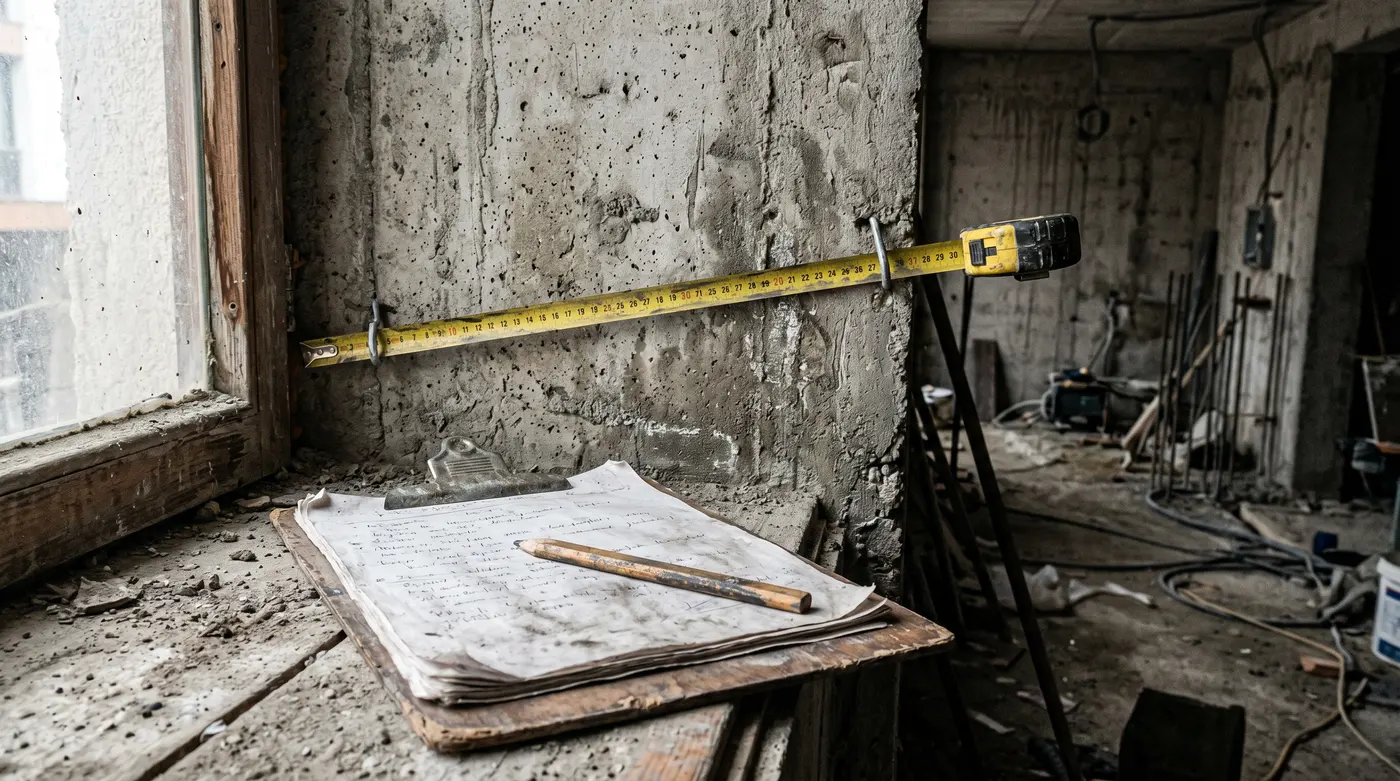 An accurate price starts with an on-site take-off and the identification of detail points — a figure given over the phone is no more than a guess.
5. Surface Preparation Requirements
Scraping off loose plaster, filling cracks with repair mortar, forming cove fillets at the corners... Surface preparation can account for up to 30% of the total job. On old and damaged surfaces this item is markedly higher than on new concrete.
6. Access and Logistics
Confined spaces such as lift pits, basements full of belongings, night-only working windows on car-park levels, or excavation being impossible in Istanbul because of adjoining buildings — each of these affects the duration of the job, and therefore its cost.
7. Material Quality
There are serious performance differences between materials that supposedly do the same job. In crystalline systems the price is driven by the proportion of active chemicals; in injection resins, by flexibility and swelling capacity. In our own work we use the products of our own brand, Dryvatec — as the manufacturer of the material, we know its composition and performance first-hand.
8. Warranty and Workmanship Guarantee
A company that offers a written warranty prices in the cost of standing behind its work — that is not a disadvantage, it is your security. The low price of crews who offer no warranty, or only a verbal "don't you worry" promise, hides the second invoice you will pay when the problem comes back.
The True Cost of Cheap Work
The price of a failed waterproofing application is not just the money paid: blistering paint, mouldy belongings, lost tenants and — most importantly — progressive structural damage driven by rebar corrosion. Waterproofing done a second time almost always ends up costlier than a job done right the first time, because stripping out the first application and repairing the damage are added to the bill.
6 Questions to Ask When Requesting a Quote
- Do you quote prices without a site survey? (If they do, be careful.)
- How did you diagnose the source of the problem — which measurements did you take?
- Which method do you recommend, and why? Did you consider the alternatives?
- What is the brand of the material to be used, and can I see its technical data sheet?
- Is the warranty in writing — what is its duration and scope?
- Where are your reference projects — can I see them?
Frequently Asked Questions
Does the waterproofing price include VAT and materials?
It varies from company to company; ask for materials, labour, transport and taxes to be itemised separately in the quote. An itemised quote also makes comparison easier.
Is it cheaper to have the work done in winter?
More flexible scheduling is possible in low-demand seasons; however, if there is an active leak during the rainy season, intervention should not be postponed anyway. The dry season is when the problem "sleeps" — not when it is solved.
Does insurance cover the cost of waterproofing?
Home insurance policies generally cover sudden, unexpected plumbing damage; damage caused by a long-standing lack of waterproofing is usually excluded. We recommend checking your policy.
Site Surveys and Information in Istanbul and Izmir
As İMG Yapı Yalıtım Mühendislik A.Ş., we carry out on-site surveys across Istanbul and Izmir and provide diagnosis-based, fully itemised written quotes. All our applications are covered by a 5-year written warranty. Fill in the building information form and our technical team will get back to you within 24 hours — or call us: 0850 532 6 999