
The most expensive mistake in waterproofing is the right application in the wrong place. The stain on your ceiling could be caused by the terrace waterproofing, by the upstairs neighbour's bathroom plumbing, or by rain entering through a façade joint. Any intervention made before the source is found is a gamble. In this article we explain the methods we use in professional diagnosis, and how you can narrow down the source with your own observations.
Step One: Reading the Stain Pattern
Water marks say a great deal about their source:
- Yellow-brown rings on the ceiling: Water is arriving intermittently from above — a wet room on the floor above, a terrace or the roof. Each ring is one "wetting-drying" cycle.
- A band climbing up from the base of the wall: Rising damp drawn up from the ground by capillary action; usually accompanied by salt crystals.
- A stain around a window or corner that darkens after rain: Water entering through the façade or a joinery detail.
- A patch that stays wet and never dries: A pressurised plumbing leak is highly likely — a meter test should be carried out.
- Widespread damp plus a musty smell in the basement: Penetration through earth-retaining surfaces; the basement waterproofing needs to be examined.
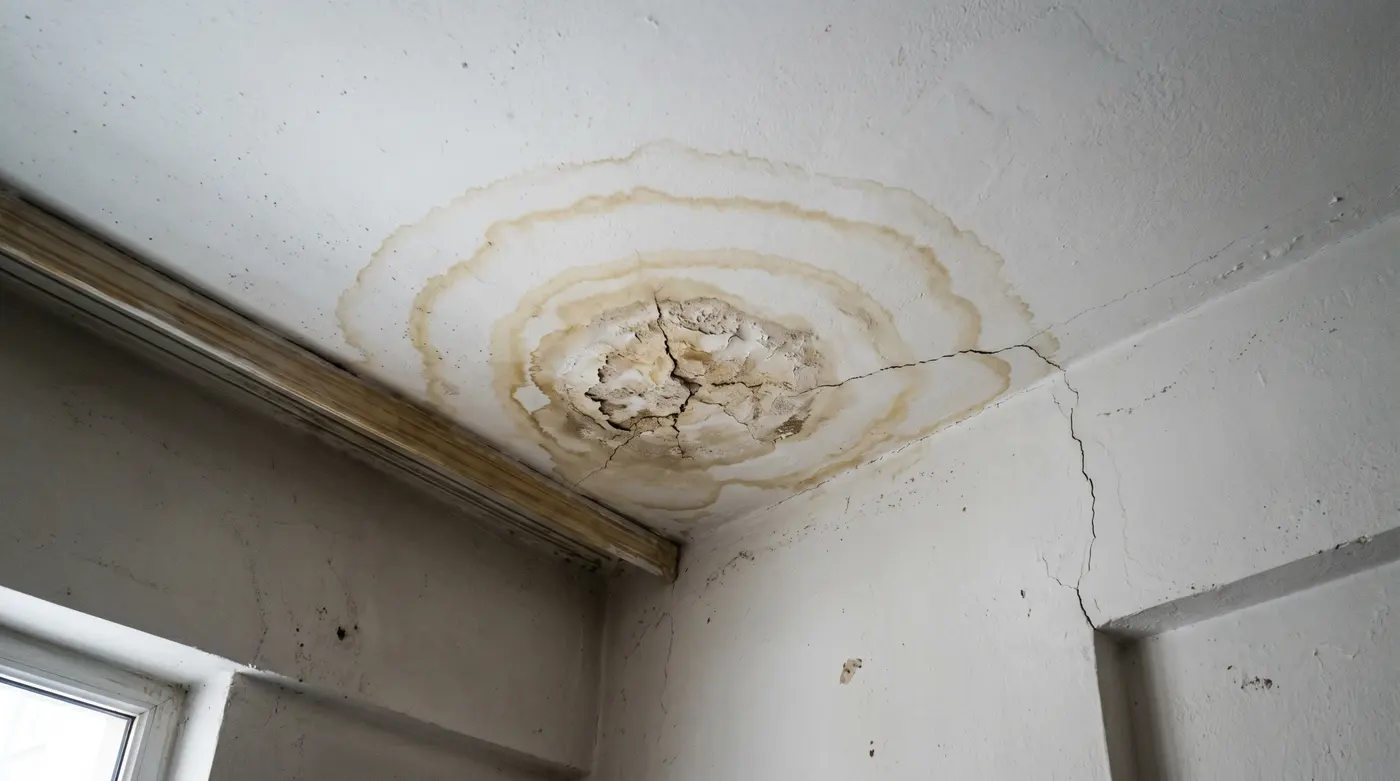 A ringed ceiling stain: each ring is one wetting-drying cycle — the sign of an intermittent source (rainfall or water in use).
Professional Diagnosis Methods
1. Moisture Measurement and Moisture Mapping
The wall is scanned on a grid with contact and non-contact moisture meters, and the moisture level of each zone is mapped. The point of highest moisture concentration is very often not the source itself but the point where the water collects — the map makes it possible to trace the water's path back to its origin.
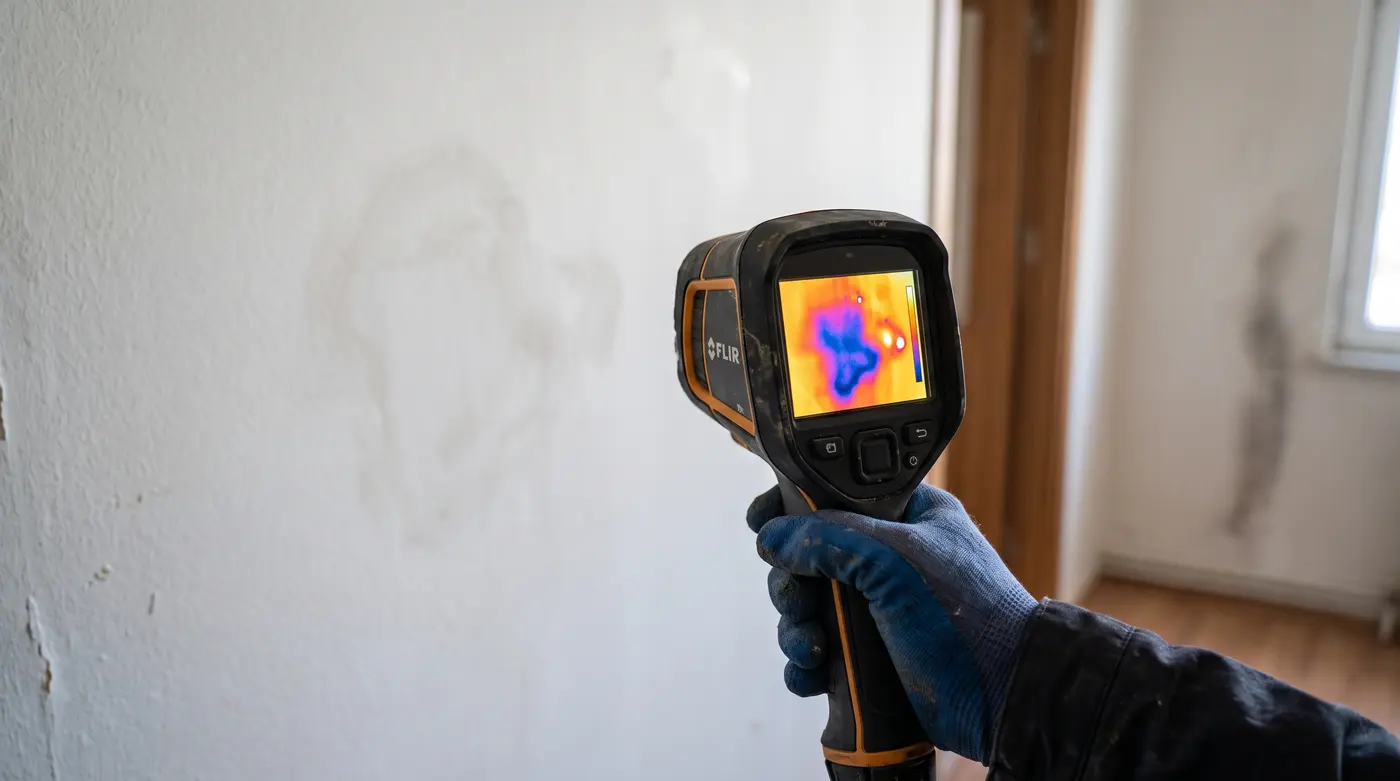
2. Thermal (Infrared) Imaging
Because of evaporative cooling, damp surfaces are a few degrees colder than dry ones. A thermal camera makes that difference visible: moisture inside the wall that the eye cannot see, a cold trail running along a pipe route, or an insulation defect appears on the screen. Thermal imaging is the most powerful non-destructive survey method (no opening up of the wall); on its own, however, it is not conclusive — it is verified by moisture measurement.
3. Wetting (Water) Test
The suspect surface — terrace, façade, around the joinery — is wetted zone by zone under controlled conditions while the stain on the floor below is monitored. Whichever zone revives the stain when wetted pinpoints the source. It looks simple, but it demands patience and a systematic approach: zones are tested one at a time, with drying time allowed in between.
4. Plumbing Pressure and Meter Tests
With all taps closed, the water meter is observed; if the meter is still turning, there is a leak in a pressurised line. In closed-circuit tests the line is pressurised with a gauge and the pressure drop is measured. This test settles the "plumbing or waterproofing?" question definitively.
5. Drainage and Outlet Tests
Water with tracer dye is fed into terrace outlets, box gutter runs and rainwater downpipes; the colour of the leak gives the source away. In terrace-related problems, the area around the outlet and the box gutter details are the points where defects are found most often.
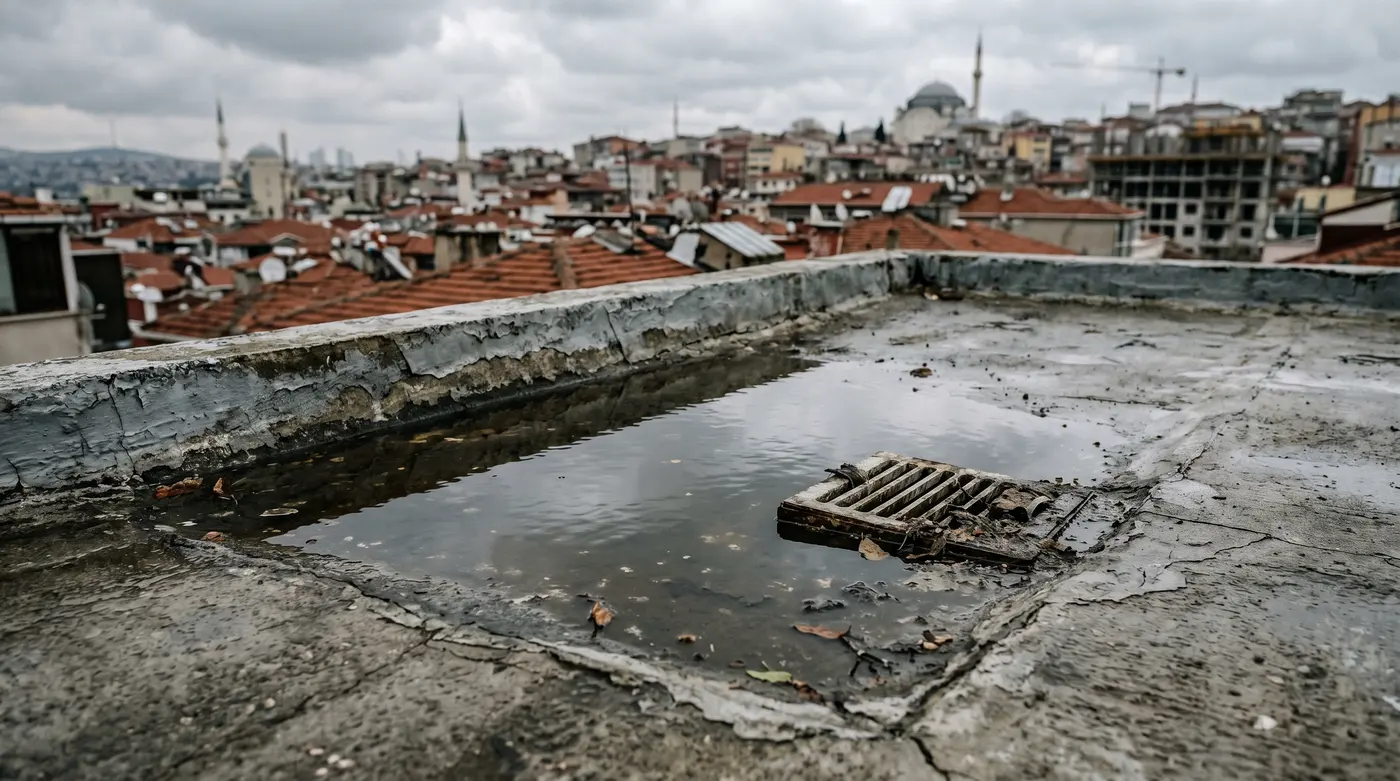 Ponding around the outlet: the classic sign of a fall and drainage defect. Standing water finds its way through the smallest capillary in the covering.
Why Diagnosis First, Quote Second?
You pay for a wrong diagnosis twice: first for the application that doesn't work, then for the real solution. The scenario we see most often in the field is external wall insulation applied to a flat that actually has a plumbing leak, or an internal wall painted against water coming from the terrace. Diagnosis is the combination of measuring instruments, experience and building knowledge — there is a reason it sits at the top of the factors that determine the price.
The İMG Mühendislik Diagnosis Process
- Preliminary information: The building information form captures the age of the building, the history of the complaint and photographs.
- On-site survey: Moisture measurement, thermal scanning where required, analysis of staining and salt deposits.
- Source report: The source of the problem, the recommended method and an itemised cost breakdown are presented in writing.
- Application + warranty: Application with Dryvatec products and a 5-year written warranty.
Frequently Asked Questions
Can a leak be found without opening up the wall?
In most cases, yes: moisture mapping, thermal imaging and pressure tests are non-destructive methods. Opening up is done only once the source is confirmed, and only at the repair point.
How do we tell whether it comes from the neighbour or from our own flat?
It is differentiated by the position of the stain, its correlation with usage times (worsening after bathroom or kitchen use) and, where necessary, simultaneous testing in both flats. An inspection coordinated with the building management speeds up the process.
Can testing be done without waiting for rain?
Yes — that is exactly what the wetting test is for: without waiting for rain, the façade or terrace is wetted zone by zone under controlled conditions to track down the source.
Leak Detection and Solutions in Istanbul and Izmir
Across Istanbul and Izmir, our technical team is in the field for leak source detection and permanent waterproofing. For a site survey and information, reach us on 0850 532 6 999 or fill in the building information form.