Ask anyone to name a waterproofing material and the first answer is usually the membrane. But "membrane" is not a single product; it is a family of materials whose working principles, application methods and durability differ widely. Choosing the wrong membrane means a waterproofing layer that cracks and takes in water at the laps within a few years. In this guide we explain what a membrane is, what types exist and which one is right in which situation.
What Is a Membrane?
A waterproofing membrane is a material that forms a continuous, flexible, watertight barrier layer over the surface to which it is applied. Its job is to cover surfaces such as terraces, roofs, foundations, retaining walls and wet rooms with an unbroken seal against the passage of water. A good membrane has two essential properties: watertightness and the flexibility to accommodate the movements of the structure.
Types of Waterproofing Membrane
1. Bituminous (Roll) Membranes
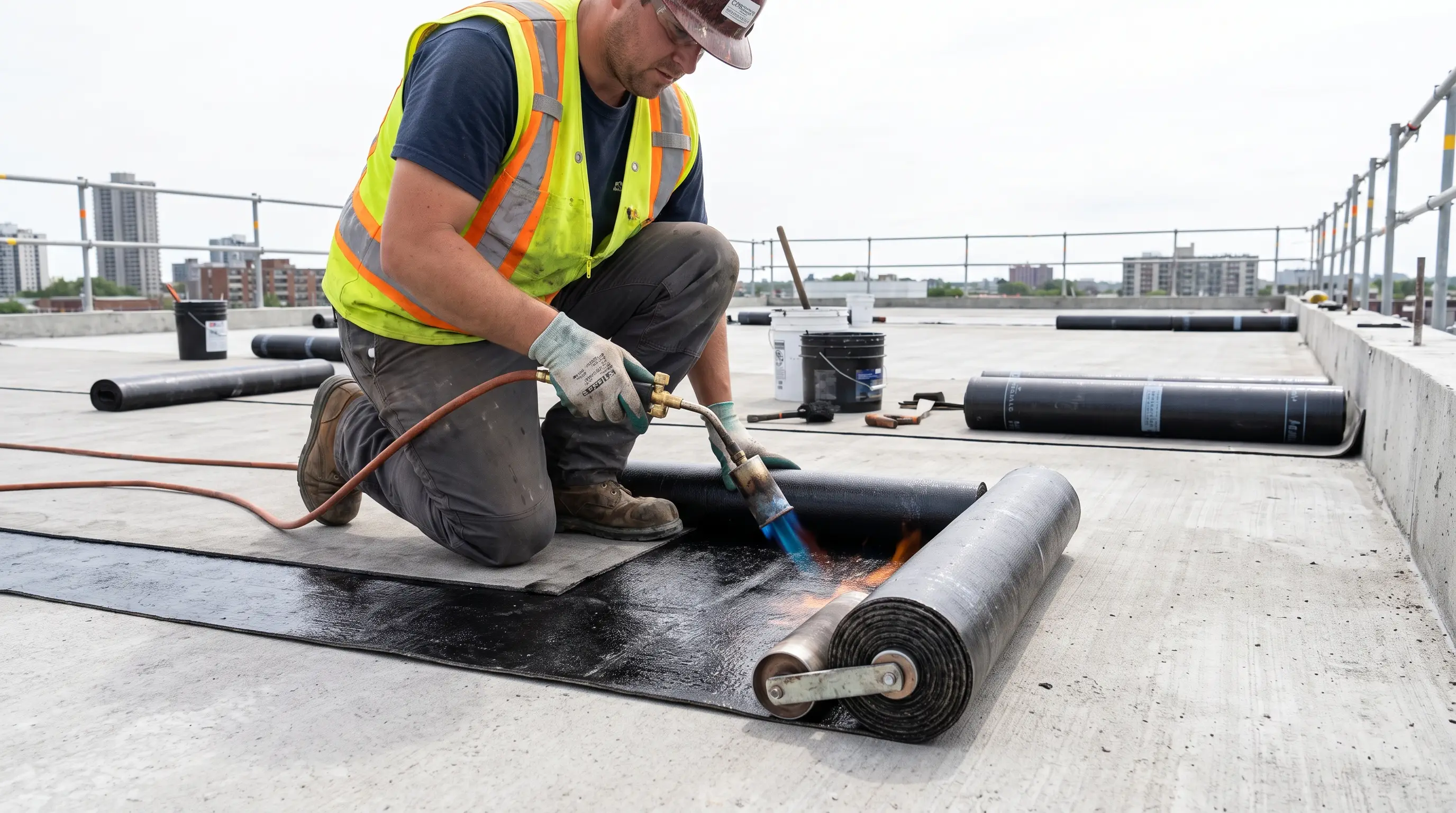
These are membranes supplied in rolls, consisting of a glass-fibre or polyester carrier coated with bitumen. They are laid by torch (open flame) or cold bonding; the sheets are joined with overlapping laps.
- Where they excel: terraces, roofs, foundations, large flat surfaces.
- Watch out: flawless workmanship at the laps (overlaps) is critical; most failures occur at the joints.
2. Liquid-Applied Membranes
Polyurethane- or acrylic-based coatings applied by brush, roller or trowel that cure to form a seamless (joint-free) film. They offer a major advantage on detailed, many-cornered surfaces.
- Where they excel: wet rooms (bathrooms, WCs), balconies, surfaces with complex geometry, pipe penetrations.
- Advantage: with no laps, there are no weak points.
3. Synthetic (TPO / PVC) Membranes
Modern thermoplastic roll membranes whose seams are welded with a heat source. Thanks to their high UV and ageing resistance, they are the preferred choice on large roofs in particular.
4. Crystalline / Cementitious Coatings (Slurry-Applied)
Cementitious tanking slurries that penetrate the concrete and provide watertightness from within. Although technically they work differently from the "membrane" family, they are widely used in waterproofing. More detail: integral crystalline waterproofing.
Bituminous membrane installation: the keys to success are proper surface preparation and flawless lap (joint) detailing.
How to Choose the Right Membrane
The choice is made according to the type of surface, its geometry, the water load and the loads that will bear on it:
- Large flat terrace/roof: bituminous or synthetic roll membrane.
- Wet rooms, balconies, detailed surfaces: liquid-applied membrane.
- Pressurised water, concrete surfaces (basement/foundation): crystalline coating or a suitable membrane + drainage.
We have brought the whole logic of material selection together in our waterproofing materials selection guide.
Frequently Asked Questions
Which is better — a membrane or a crystalline coating?
"Better" depends on the surface and the problem. For pressurised water working into concrete, crystalline systems come to the fore; on large surfaces such as terraces, the membrane does. In most projects the two are used together in different areas.
How long does a membrane last?
It varies with material quality, workmanship and UV protection. The most critical factor is the installation: a quality membrane laid correctly lasts for many years, while an application with faulty laps can start letting in water within a few.
Can a new membrane be laid over an old one?
In some cases it is possible with compatible systems; however, if the old layer is loose, blistered or has trapped water beneath it, it must be stripped off. The decision is made at an on-site survey.
Membrane Waterproofing in Istanbul and Izmir
As İMG Yapı Yalıtım Mühendislik A.Ş., we select and install the right membrane for terraces, roofs, foundations and wet rooms across Istanbul and Izmir. We use the products of our own brand, Dryvatec, and provide a 5-year written warranty. For a site survey and further information, fill in the building information form or call: 0850 532 6 999
Related services: Flat Roof & Terrace Waterproofing · Wet Room Waterproofing · Retaining Wall Waterproofing